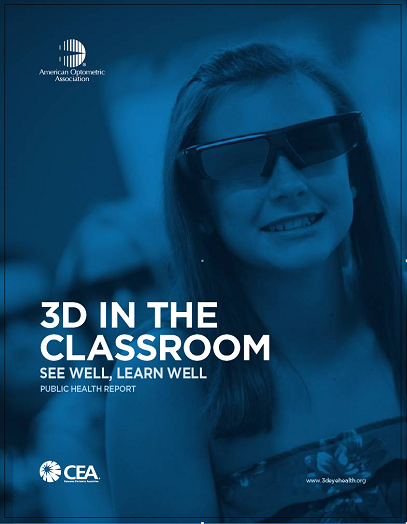
Is
there really a direct connection between a child’s ability to read and the
ability to see in stereo (natural binocular vision). Yes there is! See this
recent study (click on the PDF) for some advanced medical insight:
Thoughtful discussions about emerging and high-leverage technology use in education.
March 14, 2016
March 7, 2016
3D Vision and Early Readers
Reading.
What does it take to be successful? Part of the answer is physiological. For
the early learner, how well vision works is vital. Children’s eyes must be able
to track, focus, and team (work together). Successful reading requires our eyes
to track a line and focus on a word or letter—and our eyes must do those things
together, or team. Healthy vision deeply influences a child’s achievement in reading, learning,
success in sports, and future career choices.
Enter
modern day virtual reality. Virtual reality experiences are a hot-button
technology these days. But is this immersive technology safe for our eyes? Of
course, the answer is yes. But there’s a deeper story here. 3D virtual reality
experiences also require our eyes to track, focus, and team. Sound familiar? Those
are the same capabilities required for successful early reading, as described
above.
I
am writing this from Austin, Texas, while presenting here at the SXSWedu
conference. Our presentation involves how 3D and VR technologies are being used
to screen for and improve early childhood vision. And to screen for potential reading
inhibitors. Bet you didn’t know there was a direct connection. Now you do!
February 29, 2016
Meet Dr. Jen Simonson
Dr. Jen Simonson (OD, FCOVD) of Boulder (CO) has developed a comprehensive 3D vision testing tool for both in-clinic
and home practice use that runs on the iPad. Working with Gerull
Labs, Dr. Simonson developed the free OPTO app. OPTO is currently in limited use in the U.S., England,
Spain, Belgium, Greece, Australia and New Zealand. OPTO uses anaglyph or
side-by-side 3D to both diagnose and treat a variety of vision anomalies.
| Dr. Jen Simonson, OD, FCOVD |
These
vision anomalies can affect 5-15% of the population. These vision issues limit our quality of life, the learning success of students, or the career
choices of adults, if not treated. Using the OPTO app, Simonson notes: “We can
detect if you cannot see 3D; we can measure how small of 3D you can see”,
adding “we can quickly see if you need a more comprehensive eye exam.”
(Incidentally, Dr. Simonson was well on
her way to diagnosing me in minutes, discovering my own amblylopia with her
iPad app, even though I had not shared my own vision issue problems with her.)
From the answers provided by the patient using the app, Dr. Simonson can
correctly identify which eyes are being used to see and if one eye is
experiencing suppression. Dr. Simonson explains in lay terms: “In vision
therapy, we work on tracking, focusing, and eye teaming (when both eyes align
and look at the same place). We can change the size of the target to see how
much is suppressed; and determine whether central or peripheral vision is being
suppressed. Even if the patient is too young to read or cannot speak English,
that patient can still touch or point”, Simonson beams.
By developing her app on a mobile device, Dr. Simonson
effectively leaps over some of many hurdles faced in currently diagnosing and
treating vision disorders. The app is easy to administer, get lots of good
information quickly, and provides valid diagnostic testing that is fun for kids
to do, at multiple ages. Vision testing isn’t like it used to be: with Opto,
children can be presented with a magnificently rendered stereo 3D dog and asked
to pet the nose of the dog. What the children does at that moment—and where
they stroke the dog (or cat)—informs the doctor how much 3D these children can
see, even if they cannot verbalize. Older children and adults can even use a
stylus for certain advanced tests.
Making this diagnostic and treatment device work perfectly
across many different devices is a long term goal for Dr. Simonson. For now, it
is easier to use only the iPad for clinical testing accuracy. Although many of
her medical colleagues already like what they see in Opto, Dr. Simonson has launched
a lengthy clinical testing trial (health review boards require rigorous
clinical testing). The clinical trials are called VIVID (Validation of iPad
Vision Diagnostics) and are being conducted in collaboration with The Ohio
State University. After clinical testing, the plan is to take the app
nationwide.
February 22, 2016
3D and Your Vision
With this revelation, the myth that the 3D experience was
“bad for your eyes” or “bad for children” rapidly dissolved. With the launch of
the AOA research, schools of optometry and vision health professional
associations launched an aggressive multi-year training effort to bring the
medical community up to speed in the diagnosis and treatment of what has become
known as the 3D vision syndrome. And you knew it wouldn’t be long until that
same vision revolution hit mobile devices. In next week’s post, we will introduce
the work of a leading optometrist/vision therapist who is moving rapidly to
bring 3D vision testing to the iPad, with great success. With a surprising
educational twist.February 15, 2016
Previewing SXSWedu
During the last
decade, the very best ideas in education and technology could be scouted by listening to a TED talk. Times have changed. Move over TED,
because the annual SXSWedu phenomenon has rapidly outpaced the
TED talk as the most innovative, fresh, and prognostic venue for envisioning
the future of the education. This year, the SXSWedu®Conference & Festival will be held in Austin, Texas from March 7-10. SXSWedu
is a part of the SouthbySouthwest family of conferences, fostering “innovation
in learning by hosting a diverse and energetic community of stakeholders from a
variety of backgrounds in education.”
Conference session
analysis can give us
particular insight. The biggest footprint
in ed tech coming out of the 2016 SXSWedu conference appears to be stout
arrival of the virtual reality meme. Here are the sessions now approved in
the first wave of program announcements:
The session will
showcase how VR experiences significantly enhance learning through various curricular
disciplines. It also shows how VR is being used to address pedagogical
challenges (such as building empathy with the other), through collaborations
between teachers, students, researchers and entrepreneurs from different
countries (Israel, Brazil, Mexico, Spain, USA). See this slide presentation.
Learning
Through Virtual Reality Experiences.
In this workshop, Maya Georgieva (New York University) and Emory Craig (The College of New Rochelle) analyze how immersive wearable technology reshapes the teaching-learning environment and institutional culture, “raising fundamental questions about the shape of future media, narrative and storytelling.”
Virtual Exchange Meets Virtual Reality
Students from Los Angeles were “dropped into” a virtual reality recreation to understand the realities of the Syrian crisis. They then connected these students with Syrian refugee youth in Amman, Jordan via virtual exchange. A most interesting mashup of old and new virtual technologies.
Using 360º Spherical Video as a Teaching Tool.
Bethanne Tobey and Mike Cuales, professors from North Carolina State University explore the use of 360º spherical video to better support lab-based and field-based instruction in online learning environments. This session is unique in that it demonstrates the use of virtual reality field-based simulation. See this video.
Augmented Reality: Engaging a Minecraft Generation.
More in the augmented reality arena, this session will highlight the way educators and students are using augmented reality to comprehend learning complex concepts and retain information easier.
See2Achieve: Virtual Reality, Vision and Learning.
The only entry in the early learning category for virtual reality (all other topics focus on older students), this session features Dr. Jennifer Simonson of Boulder Valley Vision Therapy and Len Scrogan (that’s me!) from the University of Colorado-Denver. The crux of this presentation is that successful reading requires our eyes to track a line and focus on a word or letter—and our eyes must do those things together. Enter modern day virtual reality. 3D virtual reality experiences also require our eyes to track, focus, and team. This presentation shows how virtual reality is fostering unanticipated benefits for vision health and learning; and how new mobile 3D technology is being used to screen for and improve early childhood vision.
At the SXSWedu conference, 3D virtual reality is no doubt turning out to be a favored son. Even more
interesting are the creative twists we are seeing for VR in the areas of online
learning, virtual reality mashups, vision health, emotional intelligence, and
the future of storytelling. The only entry in the early learning category for virtual reality (all other topics focus on older students), this session features Dr. Jennifer Simonson of Boulder Valley Vision Therapy and Len Scrogan (that’s me!) from the University of Colorado-Denver. The crux of this presentation is that successful reading requires our eyes to track a line and focus on a word or letter—and our eyes must do those things together. Enter modern day virtual reality. 3D virtual reality experiences also require our eyes to track, focus, and team. This presentation shows how virtual reality is fostering unanticipated benefits for vision health and learning; and how new mobile 3D technology is being used to screen for and improve early childhood vision.
February 8, 2016
The 3D-printed Dancer
Here's a delightful video my wife introduced to me, a video with a 3D theme. Enjoy!
February 1, 2016
What's in a name?
As indicated in last week's post, clearly, the abbreviation ‘3D’ is currently disappearing from some digital product marketing schemes, and is being replaced with other substitute words. We now must surveil for code words like “immersive”, “VR”, or “mixed reality”, to name but a few. 3D Might be hiding there. You never know. The ways we now describe 3D visualization technologies are at the same time confusing, shifting, and converging. Let’s just say that conversations are never easy in this promethean field.
Part of the complication we face is that 3D has truly become a culturematic in modern society. In my lead-in quotation from last week's post, Juliet laments:
Of course, what this means is: it matters what something is, not what it may be called. But in the education world, it sure makes it harder to hold conversations, build momentum, and do business around the notion of 3D.
January 25, 2016
By Any Other Name
JULIET:
'Tis but thy name that is my enemy; Thou art thyself, though not a Montague. What's Montague? it is nor hand, nor foot, Nor arm, nor face, nor any other part Belonging to a man. O, be some other name! What's in a name? that which we call a rose By any other name would smell as sweet; So Romeo would, were he not Romeo call'd, Retain that dear perfection which he owes Without that title. Romeo, doff thy name, And for that name which is no part of thee Take all myself.
William Shakespeare's Romeo and Juliet,
1600
I want to reveal a perception
that has consistently garnered my attention: I am finding that the term 3D is a rapidly shifting
target. It means many things to many people these days.
When someone speaks
about ‘3D’, they may be referring to immersive rendered 3D solutions; or they
may have in mind the amazing 3D room in the Pena Palace in Sintra, Portugal (see previous post); or they
may be referencing stereoscopic or autostereoscopic 3D visualization products; they
could be excitedly pushing the hottest virtual reality experiences; and they
could even be describing augmented or mixed reality offerings. And I haven’t
even mentioned 3D printing. In many cases, the actual term ‘3D’ may not be
used, as it seems to convey “bad mojo” to some folks.
Here are some
examples of this often occurring 3D obfuscation:
- Within the behind-the-scenes platform for the 2015 Horizon Report (I served as a panel expert), organizers mystifyingly separated 3D technologies into four different categories. First, they saw most 3D as consumer technology and not an educational technology; they also mentioned 3D under data visualization technologies, under a virtual reality, and under a mixed reality. You can see why 3D didn’t make the cut if they don’t quite agree on what it is!
- Many articles or press releases I read about virtual reality or mixed reality products are using stereo and/or rendered 3D, but these articles often steer clear of the “3D” moniker.
- Manufacturers, committees, and school technologists are constantly mixing up these technologies in their minds and lexicon.
- Chris Chinnock of Insight Media writes in a recent article: “This is how 3D is going to come back to life—via a VR headset.”
January 18, 2016
3D Fun in Portugal
Portugal is an amazingly beautiful and friendly country. It also has a sophisticated 3D industry underway. But on a recent trip I found a few fun things in the 3D realm, during my outgoings from Lisboa.
If you get a chance, try to visit the amazing 3D room in the Pena Palace in Sintra, Portugal. The palace features an entire room that looks like it has depth, but it was painted on!
![]() |
| The 3D Room in Pena Palace, Sintra |
I also noticed this product beckoning on a Lisboa shelf:
![]() |
“Cada pedaço de 3D's leva-te a uma dimensão desconhecida: Vais desfrutar três vezes mais!"
“Each piece of 3D's takes you to an unknown dimension : You'll enjoy it three times!”
|
And now, apparently, 3D now applies to new dimensions of taste!
January 11, 2016
Learning About 3D
Are
you interested in learning more about 3D? Here are two friendly resources to help you on your way:
A New Book on 3D. Miriam Ross,
one of the brightest people I have met online, has released a new book that
translates well for 3D enthusiasts and can benefit educators as well. It
is entitled 3D Cinema: Optical Illusions and Tactile Experiences. According to
Dr. Ross, the book is a bit different from many of the books that have already
been published on 3D based because it is rooted in Humanities theoretical
analysis. See these preview pages.
A Useful 3D Knowledge
Collector. David Briggs, the co-founder of the Neo3do
autostereoscopic 3D tablet, purchased and now runs operates an informative
website on all things 3D, 3D Focus. It’s a good place for educators to learn
what’s happening in the broader 3D world.
January 4, 2016
3D Events
3D Design Contest in the Planning. The huge Texas Computer Education Association (TCEA) is moving forward on a 3D design contest for students to be held in 2016. The contest will have students design a solution to a given problem using 3D drawing software such as SketchUp Pro, which is provided free to TCEA members. For details contact info and details, see this link: SketchUp Pro.
VREP
Showcase Feted. The Annual Iowa
VREP Showcase is scheduled to be held on April 14, 2016 in Des Moines, Iowa. This event focuses on 3D animation, video and printing
contests, with scholarships at stake. A 3D scanning component is now being added.
New L.A. VR and Immersive
Technology Meetups . A
recurring series of meetups for 3D VR and immersive technology enthusiasts are underway by none other than the Creative Technology Center’s founder (and
Iggy Pop rock star), Michael Page. I mention this here because I have met a
large number of these folks, and they are deeply interested and committed to 3D
in education. It’s a good group to get to know, if you find yourself in
Hollywood. The meetups occur twice a month. See the signup site here.
December 28, 2015
3D Tidbits
What's trending?
News
from Outer zSpace. Talk about smart
moves. zSpace has been wisely cozying up with symbiotic partners and pursuing
powerful use cases. Their recent partnership with the Living Heart Project, a
collaboration to develop and validate personalized digital human heart models
and establish a unified foundation for cardiovascular medicine is sure to turn
the heads of both the medical community and medical educators.
3D Model
Creation Using Smartphones. Carnegie Mellon University researchers in
Pittsburgh have successfully explored the use of ordinary smartphones as
scanning devices for the creation of 3D models. Lots of implications here for
education. See this link for more information.December 21, 2015
News from Sensavis
The Lincoln County School District in Southeastern
Nevada can now produce their own professional development videos
with high quality content on their own terms. With this
district-wide licensing, teachers can share their best videos to their students
working with “flipped classroom”, prepare substitute teachers with lesson
resources in an instant, and as well as support students with personalized tutoring
videos for class. “Lincoln County School District is energized and thrilled to
partner with Sensavis. and provide our teachers the opportunity to incorporate
an interactive 3D Classroom curriculum resource into their instructional
strategies,” says Steve Hansen, Superintendent for Lincoln County School
District. Fredrik Olofsson, CEO for Sensavis AB, the Swedish-based parent
company of Sensavis, adds: “The 3D Classroom brings to Lincoln County School
District a state of the art teaching tool that will enable students to grasp
hard to understand concepts through stunning visuals.” Tiffany Kelly, CEO of
Ed10x , explains: “It takes our Professional Development initiatives to another
dimension… it fulfills one of our goals of capturing the students in those
first few minutes of each lesson with technology enriched teaching methods. She
adds: “Ed10x will also be working with Sensavis to develop a video lesson
library and a peer to peer video library”.
Considering last week's post on Presente3D's new pricing, can you see a trend here? Again, we are beginning to
rightly move away from the ponderous and onerous seat pricing model that has so
plagued 3D in education to date.
December 14, 2015
Presente3D News
Presente3D sells
the best 3D PowerPoint plug-in I have seen on the market, and now they have
raised the ante. Or should I say, lowered the ante? They have lowered their
plug-in product cost to $9.95 per user for the education market. See this offer. Dennis Cafiero, the company
president, noticed a tripled uptick on purchases with the lowered price: “What
I noticed was when people were buying it at this [price] level, the average
user was buying for 3 pc's.” Frankly, this goes a long way to solve the problem
of multiple user acquisition in cash-strapped schools. 3D costs are too high
for education customers, and this is one of the first of many manufacturers I
now see going for the advantages of volume purchasing. Smart move. Presente3D will also be releasing a 3D video
player and image converter in the near future.
December 7, 2015
3D in Higher Ed (2)
There is a "story behind the story" related to last week's post about 3D education in a higher education setting:
In China, Radio and
Television Universities (RTVUs) are open higher education institutions that
conduct distance education using interactive multimedia courseware, online courses,
and satellite-based distance learning. These RTVUs were created to improve the quality
of the work force, adjusting to a large number of learners, particularly in
support of non-degree education. To that end, RTVUs operates educational
programs for community education centers, municipalities, counties, business
and industry needs, rural areas, remote areas, and regions inhabited by ethnic
minority groups. Their advantages include lower costs and quicker graduation
schemes.
We see a similar
trend in U.S. colleges and universities. The trend is described in a recent
book by Richard DeMillo, From
Abelard to Apple. The theme of DeMillo’s books is that “any college or
university can change course if it defines a compelling value proposition (one
not based in "institutional envy" of Harvard and Berkeley) and
imagines an institution that delivers it.”
There’s the rub. Smaller and less
influential institutions, like these Chinese RTVUs, now seek to accommodate
large numbers of new learners in quick and cost effective ways, at the same
time competing for students with more well-known and well-endowed universities.
One way such second-tier schools are competing is through providing cutting
edge visualization tools. (See my recent article, Nevada
State College Flies High with 3D.) In both the Nevada State example and the
Chinese Jiayuguan Branch RTVU, 3D visualization becomes much more than a
sexy technology acquisition—it becomes a value proposition for the school. A
draw for students. A competitive edge. A necessity. What are the implications
in this story? Some of the most promising--and most likely--pacesetters for
display technologies are smaller colleges, universities, and technical schools.
November 30, 2015
3D in Higher Ed: China Edition
The Jiayuguan Branch
of Gansu Province’s RTVU (Radio and Television University) announced their first “3D Guide Simulation Experiment & Training Room.”
This is a “Multi-Channel Dome
Projection System”, one which employs VR technology to simulate 3D stereoscopic
scenery. (For more information on dome projection systems in general, see this link.) The project was funded jointly
by the Gansu Provincial Department of Education, which invested 1 million Yuan,
along with the Jiayuguan RTVU Branch, which provided an additional 300,000 Yuan
for the solution.
According to a
spokesperson, students sitting in the new training dome can “travel forty
thousand kilometers per day in one place” and are freely able to explore many
famous scenic spots around the country. The scenes created by this immersive
virtual simulation display environment are uniquely placed “within arm’s reach.”
The platform can also support 3D films, pictures, PowerPoint, audio/video
files, video conferencing, and distance learning.
The solution is used
for training students for the growing tourism and hospitality industry in
Jiayuguan City (known for the in Jiayuguan pass, the Great Wall, tombs,
glaciers, stone carvings, mounds, and glider recreation), which has experienced
rapid growth in the last few years. Using the platform, students are able to
practice tour guide explanation and language skills. The RTVU also plans to use
the dome for simulation practice and teaching in the specialties of mechanical
engineering, auto repair, and architecture.
November 23, 2015
The Way Forward (3)
In his insightful book, Think
in 3D, DeSouza points the way to the
future for 3D. DeSouza emphasizes three main ideas, in his efforts to provide a way forward for 3D. Here is the third.
Selective Focus. DeSouza describes a film-making technique he calls the “circle
of isolation," which is also called selective focus. “The trick,” he says,
“is to completely blur out any background imagery in the scene beyond
recognition and so help audiences slowly evolve their senses to reject parts of
the scene that are not in focus.” The
main rationale behind “selective focus” is to make 3D viewing easy on the eyes,
easy on the viewer’s comfort.
What DeSouza is
describing here is sorely needed in educational content, not just in films. The
key learning of any visual experience should come clearly into focus, while
other visual aspects must take a back seat. These other aspects often become
mere ‘noise,’ confusing and misdirecting young learners. Effective educational
3D is not only about eliminating discomfort—it is also about elevating the
learning target at hand, while simultaneously reducing cognitive ‘noise.’ You
see, educational 3D cannot and should not be all about stimulating the senses
and visual overload.
*****
“Thinking in 3D” is more a journey than a
destination. It’s an ongoing process, a way of thinking about a new and
promising medium. We should take DeSouza’s profound words and ideas to heart in
education, whether students are designing 3D or learning with the help of 3D.
And if you get a chance, pick up a copy of Think
in 3D and
join the closing ranks of the dimensionally attuned.
November 16, 2015
The Way Forward (2)
In his insightful book, Think
in 3D, DeSouza points the way to the
future for 3D. DeSouza emphasizes three main ideas to provide a way forward for 3D. Here is the second.
Interactivity. DeSouza submits that it’s time for more interactivity in 3D.
“Real-time, stop-and-look-around interactivity is the way forward for a truly
immersive experience,” he says. “This emotes in the audience feelings of
belonging and identifying with the world being presented.” He issues a clarion
call for the creation of more “3D engines for realistic stereoscopic 3D virtual
worlds.”
Of course, DeSouza is on
right on target again. Although interactivity already serves as the bread and
butter in the video game industry, that is not so in 3D in education. In 3D
learning, content must change. Interactivity must be reified—it must become the thing. Current educational 3D
content manufacturers produce interactive simulations as an afterthought. There
aren’t very many. That needs to change. DeSouza predicts that this may occur within the context of 3D VR. It's something to think about.
November 9, 2015
The Way Forward (1)
Over the last month, we
took time to translate many of the powerful creative thoughts of Clyde DeSouza
into the context of education. In our next three posts, we will address the question ““What is the way forward for 3D educational content?”
In his insightful book, Think in 3D, DeSouza points the way to the future for 3D. DeSouza
emphasizes three main ideas to provide a way forward for 3D. Here is the first.
Modular Digital
Assets. DeSouza calls for the use of modular digital
assets in 3D. He defines digital assets as a reusable collection of “…3D
computer models (CGI), digital sketches, and other elements such as video clips
and animations done by artists [used to] make modern movies.”
In education, there is a
strong need for a growing and interchangeable library of modular digital assets
in 3D. Companies like 3DHub and Eon Reality are already headed down this
pathway. On the development side, some
educational 3D content designers, like Sensavis, employ an engine that ensures
new content doesn’t always emerge from a ‘made-from-scratch’ recipe. Some 3D content designers, like CubeDigico
and DesignMate, are providing substantial curriculum coverage with very broad
offerings, enough to make a difference in almost any lesson plan.
November 2, 2015
SXSW Redux
SXSW
here we come!
Thanks to all our
readers who helped vote for our South by Southwest edu (SXSWedu) 3D proposal, See to Achieve: Where VirtualReality, Vision, and Learning Meet.
The crux of this
presentation is that successful reading requires our eyes to track a line and
focus on a word or letter—and our eyes must do those things together. Enter
modern day virtual reality. 3D virtual reality experiences also require our
eyes to track, focus, and team. This presentation shows how virtual reality is
fostering unanticipated benefits for vision health and learning; and how new
mobile 3D technology is being used to screen for and improve early childhood
vision.
Out of 1300 applicants we were
accepted. For those unfamiliar with SXSW, in the U.S. this is bigger and
trendier than a TED talk. So thank you very much for helping us get accepted!
Subscribe to:
Posts (Atom)