With this revelation, the myth that the 3D experience was
“bad for your eyes” or “bad for children” rapidly dissolved. With the launch of
the AOA research, schools of optometry and vision health professional
associations launched an aggressive multi-year training effort to bring the
medical community up to speed in the diagnosis and treatment of what has become
known as the 3D vision syndrome. And you knew it wouldn’t be long until that
same vision revolution hit mobile devices. In next week’s post, we will introduce
the work of a leading optometrist/vision therapist who is moving rapidly to
bring 3D vision testing to the iPad, with great success. With a surprising
educational twist.Thoughtful discussions about emerging and high-leverage technology use in education.
Showing posts with label AOA. Show all posts
February 22, 2016
3D and Your Vision
With this revelation, the myth that the 3D experience was
“bad for your eyes” or “bad for children” rapidly dissolved. With the launch of
the AOA research, schools of optometry and vision health professional
associations launched an aggressive multi-year training effort to bring the
medical community up to speed in the diagnosis and treatment of what has become
known as the 3D vision syndrome. And you knew it wouldn’t be long until that
same vision revolution hit mobile devices. In next week’s post, we will introduce
the work of a leading optometrist/vision therapist who is moving rapidly to
bring 3D vision testing to the iPad, with great success. With a surprising
educational twist.September 21, 2015
Kill the 3D Zombies!
Whacking
the Perennial Zombies
Some pesky vision
health zombies just won’t die. I place these unwanted zombies into two
categories: lessons we have forgotten or somehow unlearned; and lessons not yet
learned.
Forgotten
Lessons. At all major conferences, I see the same thing. Many exhibitors still don’t know how to show
stereo 3D, auto-stereoscopic 3D, or 4K without causing nausea or discomfort. I
have a higher tolerance than most, yet many 4K and 3D displays in exhibit
halls are upsetting to watch. Have we forgotten? Just because
the technology moves to mobile, auto-stereoscopic, virtual reality goggles, 4K
or UHD display and beyond doesn’t mean vision issues just ‘disappear’. Would we
rather have passersby wince and hurry away—or stop, savor, and inquire? That’s
the bottom line. It’s all about the content, plainly. Showing furious rollercoaster rides, wild river rapid trips, or spiraling, head-turning motion is simply crazy. That sort of content conveys a hidden biological message to educators that the technology is somehow not ready for prime time. On the other hand, LG,
Christie, zSpace, AVRover, DesignMate, Cyber-Anatomy, CubeDigico, and several
other hardware/content manufacturers really know what they are doing. They push
their video content out to passersby in a slower “savoring” mode, which is
particularly appealing to the educational customer.
Lessons
Not Yet Learned. Over the last year, I have met with
many of the innovators
bringing new products, displays, and solutions to the ed market.
My experience thus far is that they are largely unaware of the seminal AOA work
found in See
Well, Learn Well. Manufacturers cannot expect success if they are oblivious to vision
health issues. And most innovators new to the 3D scene don’t have a
satisfactory answer to the educator or consumer with the concern that “this
gives me headaches” or “will this hurt my children?” (The common responses are
dismissive: “don’t let those children use the technology”; or “there is no
problem at all.”)
September 14, 2015
3D Vision Health (1)
Several times a year
I provide an update for our readers on 3D vision health issues. The pervasive
myth that 3D is somehow bad for us, and our children, is a stubborn one. For
that reason, we need constant reminders and fresh talking points. The release
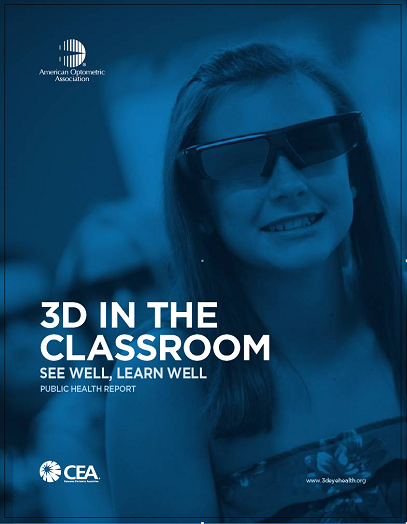
of the American Optometric Association’s seminal report on 3D vision health, See Well, Learn Well,
went a long way to dispel some of these myths, but the misinformation challenge
still persists. Here are some interesting developments:
NJIT
Continues Research
There’s good
information coming out of the New Jersey Institute of Technology these days. I
am seeing interesting NJIT research, published dissertations, and experimental
work focusing on using 3D in both diagnosis and treatment of visual disorders.
NJIT seems to be a hotbed of enlightenment in this arena. See this link
to learn more.
Right
in Front of Our Eyes
Last winter, the graduate students
of the University of Washington-Bothell developed their own child vision health
project, through a full-day symposium
entitled: “How
Undetected Vision Issues Impact Student Learning.”
This is an interesting project, one that suggests that 30% of certain
low-income children groups experience vision health issues. Of course, modern
3D technologies sit at the nexus of diagnosis and treatment of the often
hard-to-find vision challenges of children. And vision health is a strong
determiner of successful learning.
January 20, 2014
Webinar Reminder
A uniquely informative webinar on the topic of
3D and vision health in the classroom,
sponsored by ISTE SIG3D
“The Eyes Have It” features three expert speakers, a unique backchannel topic, and a vibrant question and answer session. If you want to learn more about 3D in education, 3D in Vision, and how vision health intersects with a child’s ability to learn, you won’t want to miss this powerful educational experience. Join us at the contemporary crossroads of health and educational technology.
When: Tuesday, January 21
Time: 8:oo p.m. ET / 7:00 p.m. CT / 6:00 p.m. MT / 5:00 p.m. PT
Length: 1 hour (30 minutes of presentation followed by Q&A)
Webinar Presenters
Dr. Schneebeck received her Bachelor of Arts degree in Molecular, Cellular and Developmental Biology from the University of Colorado in Boulder and her professional degree from Pacific University College of Optometry. Dr. Schneebeck is a fellow of the College of Optometrists in Vision Development, the organization certifying optometrists specializing in the area of vision therapy. She recently achieved the title of Diplomate, American Board of Optometry. She has received the Distinguished Service Award from the Colorado Optometric Association for her service to the profession of optometry. She was coauthor of the published article: “Doctor, Ergonomic Thyself”, Journal of Behavioral Optometry, Volume 15, 2004, Number 4, coauthored with Rebecca Hutchins, O.D. Dr. Schneebeck provides consulting and screening services for area schools and frequently speaks to parent, teacher, and professional groups on vision-related subjects. Dr. Schneebeck operates the Highline Vision Center , in Aurora (CO), specializing in the use of modern 3D technology in the diagnosis and treatment of visual disorders.
Dr. Yeung started her undergraduate studies at the University of Alberta in her hometown of Edmonton, Canada. She received her Bachelors of Visual Sciences and Doctor of Optometry Degree from Pacific University, Forest Grove, OR. In conjunction with her optometry degree, Dr. Yeung achieved a Masters in Education in Visual Function in Learning (M.Ed/VFL) from the College of Education at Pacific University. This degree was designed to extend an optometrist's knowledge in how vision is related to reading and learning, and allow optometrists to consult with teachers regarding students with learning related vision problems. Dr. Yeung was awarded the Tole Greenstein Award for clinical excellence in binocular vision and pediatrics. She also received the BSK Chapter Award for Exceptional Research in 2013.
A former teacher, principal, and technology director for the Boulder Valley Schools, Len was named Outstanding Technology Administrator in the state of Colorado in 2009. Len is currently a Digital Learning Architect and author of Digital Shapeshifter, a book on creative visual teaching and learning. Len is a professor at the University of Colorado-Denver and also a blogger, TEDx speaker, and recognized ed-tech author and speaker. He is a co-author of the American Optometric Association’s seminal report on 3D in the classroom, See Well, Learn Well. Len serves as the online community manager for LinkedIn’s Stereo 3D Media and Technology online community of 8,000 members. Recently, he served as a national judge for the Technology & Learning 2013 software awards and is currently a software reviewer for Technology & Learning magazine. Len is also a board member for the new ISTE SIG3D interest group and a member of the COSN Emerging Technologies Committee.
December 16, 2013
Zombie Apocalypse
Last week we continued the discussion about the recent problem with Apple’s new iPhone iOS7 making people sick. In the first post of this four-part series, I suggested that the real story is about a lesson not yet learned, in fact, about two lessons not yet learned. This week's post focuses on lesson #2.
Lesson #2: The 3D experience can provide an indicator
of underlying vision problems.
Now, if you read the
recent post of Christopher Mims, Hurl into this! Digital motion sickness will
be the occupational disease of the 21st century, you would certainly
imagine a new world threat has arrived on the scene; or at least, that the
zombie apocalypse is upon us. He complains: “I get headaches at 3D movies and
motion sick at the slightest provocation.” Apparently, the newest Apple 3D
parallax feature comes right at the heels of previous and wanton 3D
destruction. He warns of a new zombie apocalypse: “the 21st century is going to
be one you’ll want to spend hiding from just about every kind of
innovation in human-computer interfaces.” Mr. Mims is recognizing a
genuine problem, but he is partially misinformed.
Perhaps Dr. Dominick
Maino (OD, MEd, FAAO, FCOVD-A), an internationally
recognized expert in pediatrics/binocular vision at the Illinois College of Optometry/Illinois Eye Institute,
explains it best: "Vision induced motion sickness has been recognized for
decades. It is frequently called "See Sickness" or
Neuro-Ocular Vestibular Dysfunction. Many experience blurred vision,
diplopia, headache, nausea, dizziness, fatigue, malaise, and drowsiness.”
Further Dr. Maino advises
that such symptoms are treatable and therefore avoidable: “It can be successfully diagnosed and treated
by an optometrist specifically trained to evaluate the functional capabilities
of your vision. These optometrists can be found at http://www.covd.org.” He recommends reviewing an excellent presentation/discussion on this topic at:
http://visionhelp.wordpress.com/2011/07/10/the-see-sick-syndrome-when-visual-dysfunction-causes-motion-sickness/" Sometimes the solution is as simple as tweaking your
contact or glass prescriptions, as is the case with many adults. Sometimes it
can be resolved with vision correction (eyeglasses), vision therapy, or a
combination of both.
Dr. Jeri Schneebeck
(Optometrist, F.C.O.V.D), a highly respected Colorado vision expert and owner
of Colorado’s only 3D vision lab, knows that this is not just about poor 3D
design: “It’s about vision,” she
confirms. In fact, the day I interviewed her about this Apple issue, she
was reminded that she just had a patient complain to her today that she had a
significant vision problem with her new iPhone, and had returned it to the
store. Zeroing in on understanding this new Apple iPhone parallax issue,
another Colorado optometrist, Dr. Jacinta Yeung (OD, MEd/VFL), observes: “I'm
not sure I can pinpoint exactly which part of the visual system would ‘cause’
this discomfort. It is probably a combination of factors but it would be nice
to evaluate a group of these individuals to see if there is a common weakness
in their visual system.” She has also
heard of patients reporting this problem. In the meantime, folks are turning
off the effect.
So here we are again,
revisiting the vision health issues identified in some of my past posts. Most
notably, I want to point our readers to two predictions I made for the year
2013 in my post, Whither
eS3D:
- The vision health issue will struggle to
receive the attention it deserves due to inability of the medical
community to employ effective marketing and PR strategies.
- The struggle to debunk 3D mythologies (3D is
bad for you, it makes everyone sick, it hurts children) won’t go away.
We’ll still have to wrestle with those unfortunate media-generated sound bites
for some time.
Yes, we still have
our work cut out for us. Mr. Mims was correct in some ways: Poorly designed 3D can cause problems, all
by itself. You have to pay attention to these things, Apple. But he was
totally off base in terms of the bigger picture of 3D and vision health. These hurtful
zombies keep coming back to life. We just have to stop feeding them. Maybe it’s
time to bite back.
December 3, 2012
Small Miracles
It’s
been some time since I’ve offered a posting on the topic of 3D and vision
health, so please allow me to take a brief side journey back to the world of
optometry and the importance of 3D in vision health. It is important to revisit
this theme because the negative mythology associated with 3D is still so
stubbornly apparent.
In
fact, just this last week I read a movie review, written by a well-known critic,
who repeated two stubborn myths:
- "How uncomfortable cardboard 3D glasses are." (Folks, we don’t use those any more); and
- "I get headaches when viewing 3D" (My dear friend, read the research. Such symptoms serve as an indicator of an underlying vision problem, one which can be successfully addressed by your optometrist or vision therapist)
In
combatting these unfortunate misconceptions, we need every good story we can
find. And here are two good stories, worth your time:
These
stories give you a reason to teach with the 3D tools you’ve come to love or sell
the 3D resources you sell. These stories help dispel the stubborn myth that 3D
is somehow harmful. One story, one
miracle at a time—we will see the change.
October 15, 2012
San D (2)
As discussed in the previous post, 3D is really taking off in Asian
and other emerging markets. Since many of our regular blog readers come from these emerging
markets, I thought a thoughtful reminder, presented via a simple mystery, might
be beneficial: Can
you see anything peculiar in this snapshot of the first showing
of Titanic 3D in Shanxi, China? Click on it to enlarge it.
![]() |
| What's Wrong with this Picture? |
Leonard Press, a
well-known optometrist, recently observed in his blog that a number of people
are watching the film without glasses. He
explains, when “you’re experiencing
one of the 3Ds of stereoscopic 3D viewing—discomfort, dizziness, or lack of
depth—one way to cope is to simply watch without the 3D glasses – but the
experience is clearly not the same and most likely is out of focus due to
the effects necessary to create 3D-ness for your movie-going neighbors.”
Again, and this time internationally
speaking, our educational challenges remain constant. We know from the research
that 3D is not harmful in any way. But some people do experience discomfort,
which actually is an indication of underlying vision problems, not necessarily a
problem with the 3D. For a complete resource on understanding the role of 3D in
vision health and vision screening, see this well-travelled Future-Talk
3D post.
September 10, 2012
Teaching with Depth
Grasping for words. In search of just-the-right language. Looking
for richer metaphors. These best describe what has been occupying my think time
in recent months. You see, the expression ‘3D’
carries a lot of unwanted baggage.
For most, the expression ‘3D’ conjures to their minds little
more than movies—‘pokey’ entertainment. Some people immediately associate the term ‘3D’
with architectural drawings (CAD), Google Earth, gaming, or other types of “rendered
3D” objects or scenescapes. Then there’s a well-known film critic, who speaks
for many, in suggesting that “‘3D—it just makes me sick.” (He was unaware
of the research findings that indicate his discomfort is caused by underlying
vision issues, which are easily addressable. But that’s another story.)
For many others, ‘3D’ is simply not a part of their generation and therefore
not on their radar.
Using the term “stereo 3D” doesn’t seem to help either. Adding
that double-fisted adjective merely adds a pinch of technophobe seasoning to the
mix. No, I’ve been looking for a kinder, gentler pathway. So far, I have
settled on the following:
Teaching and learning with DEPTH is a pleasant way to describe how we use 3D in educational
settings. It’s an expression that is, at once, both hopeful and free of the past, largely unwarranted, baggage. So far, it seems to resonate well with educators and
educational conference leaders.
Do you have any similar musings? Other ways to
word the notion of the 3D experience? Please post them as a comment below.
August 27, 2012
3D Vision Basics
![]() |
| The 'old' way |
![]() |
| The 'new' way |
Also, watch the rough video below to see an example of how TrueVision uses 3D in eye surgery education to show clarity and depth:
August 20, 2012
3D Vision News
For the first time in history, the Opening General Session for Optometry’s Meeting® in Chicago in the last week of June featured an educational 3D experience led by a number of Hollywood dignitaries. The audience included attending doctors of optometry, students, paraoptometrics, and their families. (For perspective, there are over 60,000 optometrists in the United States alone.)
At the opening session, 3D experts Jim Chabin (president of the International 3D Society), Buzz Hayes (senior vice president and executive stereoscopic 3D producer for Sony 3D Technology Center at Sony Pictures Entertainment), Graham Clark (StereoD, LLC), and Bob Whitehill (stereoscopic supervisor at Pixar Animation Studios) demonstrated and explained the concepts of 3D as it pertains to the entertainment world. They showed 3D clips from films such as “The Lion King,” “Rise of the Guardians,” “Spiderman” and “Titanic”, among others. Many of these clips have never been seen outside their studios.
Jim Chabin, the president of the International 3D Society, stated “We ask your help in making sure stereo deficiencies are corrected.” Chabin continued, “We hope amblyopia rates can be reduced and decimated. We hope your practices can provide appropriate diagnoses. You are important partners in 3D; you are the first responders.”
![]() |
| Jim Chabin, president of the International 3D Society |
Why was this event so important? Simply stated, the science behind stereoscopic 3D is an essential step to increased understanding of 3D and stereoscopic 3D (S3D) viewing as a safe and appropriate technology for all audiences. As the popularity of 3D rises, so too will optometry’s responsibility to educate the public and assist the production studios and other 3D developments. As Jim Chabin suggests, optometrists are the nation’s 3D “first responders.” For that reason, this opening session was clearly a landmark educational opportunity.
The Opening General Session was followed by a number of educational sessions focused on the topic of 3D vision/diagnosis/treatment, along with a very comprehensive Saturday symposium on the 3D experience. During the Saturday symposium, optometric professionals had the opportunity to take a journey through the entire process of 3D, plus experience the first-ever live, heads –up, 3D slit lamp exam demonstration (a diagnostic technology developed by TrueVision). Anthony Lopez, a 3rd year student of optometry was in the audience and was fortunate to be the “first ever optometry student” to experience a slit lamp exam using this new 3D technology. There is clearly a promising role for 3D in the world of optometric diagnosis and treatment.
July 2, 2012
Vision Health News
Here's
some timely 3D vision health news from around the country:
![]() |
| Have you seen your optometrist lately? |
VPI Research Conference Held.
The Vision Performance Institute of Pacific University launched a major
symposium focused on 3D vision health. Their 6th Annual
Research Conference, was held in Oregon early June, and was entirely
focused on providing current vision health information to researchers, medical
folks, manufacturers, developers and practitioners alike. I spoke at this event
and will share some interesting findings in a future post.
American Optometric Association.
The AOA 2012 Optometry’s Meeting was held in Chicago at the end of June,
offering four major sessions on 3D vision. The last session was a full day
mini-conference called “The
3D Experience: Your Opportunity.” The AOA is getting serious about reaching
their own ranks, as well as incoming optometry students, as they launch a
two-year effort to spread the positive and important public health news. And
the good news is: the seminars were packed with pre-registrations! That's very
good news.
COVD 2012. Visual therapists (COVD)
are also lining up to provide key educational sessions focused on 3D viewing
and the use of 3D in treatment therapies at their annual conference,
being held in August in Texas.
If you are missing the context of previous posts on the
topic of 3D and vision health, here are the basics: viewing 3D—in theaters, on
home television sets, on game consoles, and in our nation’s classrooms—appears
to serve as one of the most reliable and effective vision screeners ever offered. It's apparently far more effective than the standard eye-chart test. You see, 3D projected images can now be used as a universal public health
screening tool for vision problems that previously went undetected. See this post for information from the American
Optometric Association about the benefits of 3D vision.
April 9, 2012
Opportunity Calls
This is
a message primarily for 3D technology companies (hardware and software
manufacturers, integrators, and resellers).
The Opportunity
You are invited to participate in a dynamic optometric
educational session at the American Optometric Association's annual conference, being held in Chicago on June 30th, 2012. The details
of this opportunity are detailed in the document embedded below, along with contact information.
The Business Case
There are two distinct
benefits associated with this opportunity:
First, this is an
opportunity to reach an elite group of consumers and their families. Optometrists
are in the top 12.5 percent of households per total money income according to
U.S. census data and the AOA’s Income
from Optometry survey.
Second, this event also represents an opportunity to make sure
doctors of optometry are sharing the message you would like consumers to
hear—not only that 3D/S3D viewing is a safe and appropriate technology for all
audiences, but that it can also uncover treatable vision problems.
Why It Matters
In 2011, efforts to increase awareness of the health benefits of
3D viewing resulted in more than a billion media impressions. But according to
the AOA’s 2011 American Eye-Q® survey, there is still work to be done
dispelling myths. Parents still reported some concern about the effects of 3D
technology, with:
- 53 percent of respondents, whose children are 18 or younger, believe 3D viewing is harmful to a child's vision or eyes
- 29 percent feel very concerned that their child may damage their eyes due to prolonged use of computers or hand-held electronic devices
Don’t miss this chance to ensure your message reaches consumers
through the collaborative strength of the American Optometric Association (AOA)
and 3D@Home consortium.
March 19, 2012
The Eyes Have It
On June 6th and 7th, the Vision Performance Institute is offering a seminal 3D educational experience that will be of interest to 3D educators, software developers, hardware manufacturers, and literati alike: their 6th Annual Research Conference.
This conference will feature topics such as
- vision ergonomics
- defining 3D content quality
- vision care
- S3D in the classroom
- S3D in public health
- and much more
At the conference, I
will be moderating a panel, but will also offer an informative presentation on what
is different about educational 3D content (eS3D), exactly how we use it in the
classroom, what the research is suggesting to us, and key research questions your organization should examine in future case
studies.
I strongly
encourage the audience of this blog (and especially our strong international audience) to find a way to attend this
conference. It will lend a competitive advantage to all of your hard work and efforts
in this field. Below is the flyer. I hope to see you there.
Labels:
3D,
AOA,
content,
education,
eS3d,
industry,
lagniappe,
Learning,
presentations,
Research,
stereo,
Teaching
January 30, 2012
On the Road Again
I’m doing quite a bit of presenting on 3D in education over the next six months.
Here is a current list of my schedule and topics, in case you are interested in
attending. If you are in the vicinity, it’s also always a good excuse for an
opportunity to meet, get some coffee, and have some conversation.
|
Conference
|
Month
and Location
|
Topic(s)
|
|
TCEA
|
February,
Austin TX
|
5 Workshop: When
3D Comes to School
5 Teaching in
3D: Ten Reasons Why it Works, Why it Matters
|
|
Colorado
Conversations
|
February,
Wheat Ridge, CO
|
5 Evaluating
Technology Initiatives
|
|
COSN
|
March,
Washington, D.C.
|
5 Teaching in
3D: Ten Reasons Why it Works, Why it Matters
5 21st Century
Teaching with New Media
5 Evaluating
Technology Initiatives
|
|
Vision
Performance Institute, Pacific University
|
June,
Forest Grove, OR
|
5 3D in
Education
|
|
3D
Comm
|
June,
Las Vegas, NV
|
5 Remapping
for 2012: 3D and the Education Market Space
|
|
Colorado
TIE 2012
|
June,
Copper Mt., CO
|
5 Cultivating
Your Donkey Cam Kung Fu
|
|
ISTE
2012
|
June,
San Diego, CA
|
5 Teaching in
3D: Ten Reasons Why it Works, Why it Matters
5 Workshop: When
3D Comes to School
|
|
American
Optometric Association
|
June,
Chicago, IL
|
5 Panel: 3D in
Education
|
Subscribe to:
Posts (Atom)