Showing posts with label 3D is Here. Show all posts

May 20, 2013

SIG3D Update


In a recent post, I announced that the International Society for Technology in Education (ISTE) took a landmark step in the arena of educational 3D by establishing a new Special Interest Group. Today’s post provides a timely update as the new ISTE SIG3D springs into action.

Big Growth for SIG3D
In my recent post, Whither eS3D, I made the following prediction:

The new SIG 3D formed by ISTE will double its membership and
establish a growing foothold in educational technology.”

At last year’s first interest meeting we saw approximately 47+ interested partners in attendance, mostly educators and a few manufacturers. My prediction was that SIG3D membership would grow to nearly 100 members this year. How is SIG3D doing so far? Nancye Black, the chair of the SIG3D group reports that membership has exploded to over 571 members as of April 1st.  And it’s still growing. This level of membership growth clearly exceeds all expectations.

All ISTE members are welcome to join SIG3D.  Corporate organizations are also welcome to join ISTE and then sign up for SIG3D. (Many 3D firms already pay for ISTE sponsorship and membership, so it’s simply a matter of joining the SIG3D group.) The SIG3D Website can be found at: http://www.iste.org/connect/special-interest-groups/sig3d

Newsletter Submittals Requested
SIG3D plans to provide a quarterly newsletter as a new SIG. If you have success stories, school stories, district rollouts, or new product announcements (as long as they are educationally driven), please forward your news items to iste.sig3d@gmail.com.


May 13, 2013

ISTE SIG3D Events


Two ISTE SIG3D membership events are now scheduled for this June in San Antonio at the ISTE Conference. We hope to see you there!


o    SIG Open House -- Sunday, 6/23, 3-5 PM
This is an open house for all ISTE members to investigate various SIGs. ISTE SIG3D members are invited to visit the SIG3D booth and mix with each other and potential new members.

o    SIG3D Gathering -- Tuesday, 6/25, 5-6:15 PM
This is the official SIG 3D meeting, which will incorporate a variety of activities: getting acquainted, overview, teacher poster sessions*, and breakout sessions by interests.
I will post precise meeting locations here, as soon as they are confirmed. 

*Please note that SIG3D is soliciting teacher poster presentations (on stereo 3D or 3D printing) to be conducted in the meeting during a 15-20 minute rotation period. Vendors are encouraged to sponsor talented classroom teachers or professors to attend and present at this event. Only educators may present, however. Submit your proposals or questions here.

April 29, 2013

Around the 3D World


This week’s post is a virtual “grab bag” of happenings in and around the world of eS3D (educational stereoscopic 3D). Enjoy this virtual playground, as you explore the tremendous potential for 3D in education and other related fields.

December 17, 2012

Best of Future-Talk 3D 2012

number 2 Zero Spelling Bricks green number 1 Wooden Bingo Number 2

It’s been a thriving year for the Future-Talk 3D blog, which has grown to 3,400 web impressions per month. As the year comes to an end, it is fitting to reflect on the most popular topical posts of 2012.  The top eight posts are presented below, in order of most web impressions received this year:

Actually, it’s quite thought provoking to speculate as to why these particular topics were “top of mind” in 2012 for the diverse international audience that regularly follows this blog. Please let us know your hypothesis or thinking by posting a short comment.

August 13, 2012

Summer 2012 eS3D Content Update


Below please find my Future-Talk 3D August 2012 list of producers of 3D educational content. These content producers are listed in alphabetic order, along with a few salient comments that are worth a look. Links are provided and the entire file is downloadable. If you are a 3D educational content manufacturer, and you are not yet on this list (but would like to fill me in on your intentions), please contact me directly.

                                    Open publication - Free publishing - More 3d


August 6, 2012

eS3D Content Grows


Everywhere I go, the first question educators and industry leaders ask me about 3D in education is entirely predictable: “What kind of content is available in 3D?” On LinkedIn and other websites, the same question endlessly churns on throughout the year. Here's the answer. Twice a year, I release a special report on stereo 3D content available specifically for the educational market. I call it educational stereo 3D or eS3D for short.

I started reporting my comprehensive list in January, 2010. My first report highlighted seven software companies producing stereo 3D content for the educational market. That’s all we could find at that time. Something interesting has happened along the way. Today, two-and-a-half years later, our awareness of the number of 3D educational content publishers has grown to twenty-five. That’s more than a 350% increase. And it’s still growing. Please remember—with most of this content, we are not talking about “3D movies.” In fact, 3D educational content represents a diversity of approaches and design. (See my chart below, clicking on it to expand the view.)


Another interesting development to watch is the increasing emergence of more content for the elementary classroom.

Come back to Future-Talk 3D next Monday for my Summer 2012 posting of 3D educational content producers. Next week, I will post the complete downloadable list of content producers, listing each in alphabetic order with links to the best spots in their web pages. What a great way to start the school year!

July 9, 2012

3D Olympics

We have definitely come a long way in our collective 3D journey. To corroborate my point, let’s take a reminiscent side trip to the dusty annals of this blog’s past.  During the last Winter Olympics, I posted the following post on Future-Talk 3D, The Olympics in 3D.  3D TV was relatively new then. Yes, the 3D movie avalanche had begun, but its future remained still largely in doubt. The 3D experience was still confusing to me. At that time, I was not sure how to compare stereoscopic 3D with its rendered 3D cousin.

Now brush off the cobwebs and fast forward to the 2012 Summer Olympics. No doubt here. Panasonic is a worldwide Olympic partner and is sponsoring the first Olympic games shot live in 3D. Stereoscopic 3D. You can learn more about this hallmark effort here. Laughingly, my older post represented only a wistful glimmer of what was to come. But I am no longer disappointed. The summer games start soon, so I am revving up my home 3D TV (a Panasonic VIERA 3D TV) to catch the action. Will expanded school and university use of 3D be next on the plate? I think so. 

May 21, 2012

ISTE 3D Preview


The ISTE 2012 educational conference, scheduled for San Diego in June, is offering four powerful educator presentations in the area of stereo 3D. Make plans to be there and learn about the latest in stereo 3D DLP technologies for the classroom. Click on any link to learn more.

When 3D Comes to Your School
Saturday, 6/23/2012, 12:30pm–3:30pm
Presenter: Len Scrogan, University of Colorado-Denver
This is a comprehensive three-hour workshop on everything you need to know about creating a stereo 3D classroom or pilot project in your school or district.
3D in Education
Tuesday, 6/26/2012, 5:00pm–6:15pm
Nancye Blair, McKeel Elementary Academy with Len Scrogan
This is a birds-of-a-feather gathering for teachers or leaders interested in learning or talking about teaching with stereoscopic 3D. It is an open-ended discussion focusing on emerging resources and best practices for using 3D technologies to increase student engagement and learning gains.
Exploring 3D Technology in the Classroom: Strategies and Lessons Learned
Tuesday, 6/26/2012, 1:00pm–3:00pm
Carole Hruskocy, Regis University with Sandra Foster
How does 3D technology in a science classroom affect learning and teaching? Explore this emerging technology and find out the results from a third-year extension of the BVS3D research study, presented by University researchers in a two-hour stay-as-long-as-you-want poster session.
Teaching in 3D: Why It Works, Why It Matters
Tuesday, 6/26/2012, 10:00am–12:00pm
Presenter: Len Scrogan, University of Colorado-Denver
Discover how stereo 3D visualization technology is being used effectively in K-12 classrooms, how it affects student thinking and performance, and why it matters. Presented in a two-hour stay-as-long-as-you-want poster session. 

May 14, 2012

3D@Conferences


After attending FETC in Orlando, TCEA in Austin, and COSN in Washington, D.C., I came away with a fresh wind of perspective as the 2012 ed-tech conference season began in earnest.


Learnings from FETC

Stereo 3D was not well represented.  It was visibly on display only in two booths.  In addition, the displays were not that effective. Self-running demo loops simply won’t excite educators.  There are better ways to showcase stereo 3D capabilities, folks.
Stereo 3D is not well understood by conference leadership.  Although chosen as a presenter, none of my stereo 3D offerings were selected.  That decision perplexed me, so I wrote to the conference leadership asking why they did not select one of my 3D presentations.  “We already had several 3D presentations scheduled,” they claimed, and “didn’t see the need for any more.”   The answer was mystifying, but I accepted it at face value.  Who could possibly be presenting?  Fast forward.  The conference arrived.  Once I landed in Orlando, I took thirty minutes and reviewed every session offered during the conference, scouting for the previously mentioned stereo 3D sessions.  There were none.  But there were indeed three sessions being offered on “3D virtual worlds” (rendered-3D immersive worlds, like Second Life) and rendered-3D design tools, or rendered-3D animation.  But nothing on the visualization and learning advantages of using stereoscopic 3D.  As you can see, the conference leadership did not understand what stereo 3D is.  Why? It is not fully a part of their generation or their personal culture.  It is not yet on their radar.  It should be, but it is not.  But don’t ever think it is an unreachable goal.  We just need the right messaging.

Learnings from TCEA

Texas “gets” 3D.  Numerous sessions touched on 3D at TCEA, including a half-day workshop. The presentations were well received and packed with people.  New 3D math and science content was demonstrated that convinced even the stoutest doubters.  3D content was visible in a number of projection manufacturing and reseller exhibits. DLP 3D Lamp-Free Projectors were all the buzz, with four projector companies featuring DLP lamp-free projectors.  (To the educator, lamp-free means not paying for bulbs every year—at $350 a whack.  These projectors cost a little bit more, but pay for themselves in a year and a half. In some cases, the solution was expected to last for 20,000+ hours, or 10+ years in school terms.)  I saw models from Vivitek, BenQ, Casio, and Optoma.  Again, Texas ‘gets’ 3D.

Learnings from COSN

3D is the new kid on the block. A conference for technology leaders, 3D was clearly a new experience for most. Amidst the clamor and noise of cloud-based applications and 1:1 initiatives, folks who saw examples of great 3D educational content were quite impressed. Some of the discussions I had with interested educational leaders were promising.  Educational technology leaders simply need to see great examples of 3D (not movies), in order to begin their journey towards understanding.  

February 13, 2012

Spatial Thinking


Over the next few months, I periodically plan to interview some of the educational 3D content developers that are making great strides in producing classroom-ready content. This is the first posting in that editorial line.

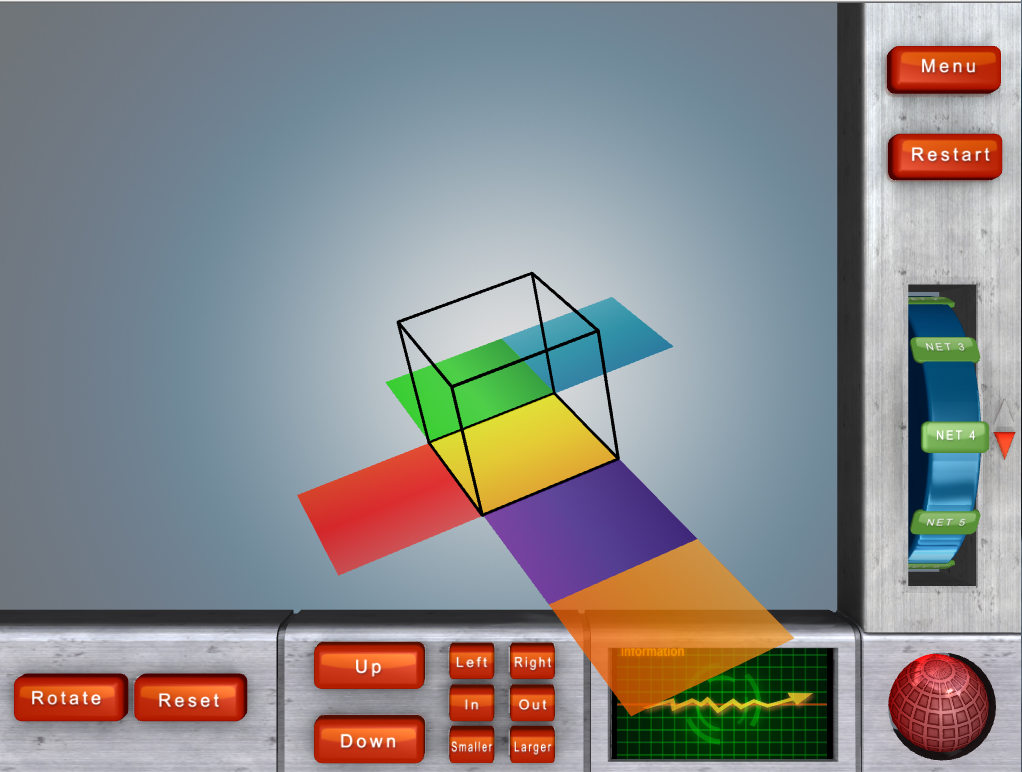
This week, we see the release of a new series of secondary-level stereoscopic 3D  math simulations by Spatial Thinking, a Los Angeles-based educational content developer, with a top-rate programming team in Beirut, Lebanon.  Spatial Thinking produces interactive simulations designed to teach difficult math concepts to students using the advantages of 3D stereo visualizationAnd it works. 

The initial 3D stereo interactives released by Spatial Thinking, with more on the way.
This software was clearly designed with the math classroom in mind, tackling the toughest problems with bravado. George Dekermenjian, the founder of Spatial Thinking, explains: “Our goal was to create an application that would serve as a bridge between the teacher’s mind and the students’ minds.

An interactive stereo 3D simulation that can be used by teachers or students to promote deep questioning and understanding of solids and their nets.

Focusing on the mathematics behind space geometry and measurement, the Spatial Thinking math series focuses on the relationships between concepts of geometry that students often feel are unrelated and disconnected. It deploys animations of more than 100+ objects to make learning connections successful for students. Dekermenjian is definitely on track when he clarifies that “any product aimed at teachers and students must be one that inspires discovery, experimentation, and engagement. “ These interactives do just that. No joke. For 3D-using educators, this software is definitely a must see, and portends a bright future for this company. Take a look.

January 16, 2012

A 3D Word Cloud (2011 Edition)


Here’s a graphic word cloud of all the key words used in our Future-Talk 3D blog during the year 2011.  The more the word is found, the larger it appears in this word cloud. (Click on the graphic to enlarge it.)


It’s quite interesting to visualize, in this way, the recurring themes and concepts that have emerged from Future-Talk 3D this last year. It’s like putting your fingers on the pulse of what’s happening in educational 3D—and taking a read.

December 19, 2011

Among the Best


This last week, the editors of eSchool News identified the “ten most significant educational stories” of 2011. Recent research on the emerging use of 3D in education made the cut. It's an interesting read. Check it out for yourself at:

October 17, 2011

Research in Europe


A large-scale European research project, under the leadership of Dr. Anne Bamford (University of the Arts, London, Wimbledon) just been released. The LiFE I (Learning in Future Education) study examined the use of stereo 3D in classrooms in seven countries, including the U.K., France, Germany, Italy, Turkey, The Netherlands, and Sweden. The project involved fifteen schools, fifteen classes, forty-seven teachers, and well over 740 students. This report is free, and available by registering at this link.

It is clear that we are observing continued evidence that the educational advantages of using 3D in the classroom reverberate across oceans and distinct cultures. It appears we are improving our understanding of the way stereoscopic 3D affects the learner’s brain, how it impacts learning in the classroom, and how teachers can leverage this new medium to an advantage.
 

October 10, 2011

Educational Effort


Clearly, one of the biggest challenges we face in 3D is educating the publicFor example, did you know that:
  • 53% of parents surveyed* believe 3D viewing is harmful to a child's vision or eyes?
  • Nintendo warns in their posted health and safety information that children below the age of six should not use their 3D technology?
  • Neither of the above concerns have a foundation in fact, based on past and current research?
* Based on the American Optometric Association's (AOA) 2011 American Eye-Q ® survey

As the K-12 educational advisor and member of the writing committee for the report, I am compelled to say that See Well, Learn Well is not only a significant national health report, but also an extraordinary educational tool for students, parents, schools, universities, manufacturers, and software designers alike. Not only is the main report well designed and classroom ready—Appendix C in the report offers a full range of websites, blogs, and other resources to extend your learning about the benefits of 3D in teaching and vision health. 

See Well, Learn Well is also supported by a rich and growing array of behind-the-scenes online resources. Go to 3D Eye Health for great videos and supporting information. This support site offers highly interesting treatments of 3D benefits, the 3D’s of 3D Vision, and how you know when it’s time to see an eye doctor. The site also offers a growing FAQ section with such timely topics as disinfecting glasses and how long a child should watch 3D.

Learn as much as you can. We are all a part of this important educational effort.

January 2, 2011

3D is Here

 
One promising projector capability (soon to arrive to a school near you) is the ability to project 3D images inexpensively, and with remarkable quality.  You know, 3D like in the movies—Toy Story, Ice Age, or G-Force.


If you’ve been going to any movies lately, you may have noticed that the 3D theater marketplace has been noticeably increasing. Expanding from just a few titles a year, we’ve seen the commercial release of over twenty 3D films in 2009, and more than fifty in 2010. Interestingly, more than a hundred 3D films are now in planning or production for 2011, queued for release by Hollywood.

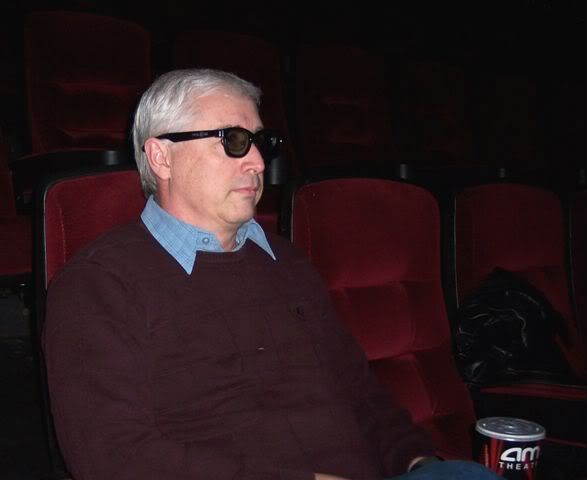
To see a picture of Len at the Dicken's Christmas Carol 3D movie, click here.
To see a close up of the newest movie goers' essentials click here.

One 3D film, in particular, seemed to revolutionize the way we think about the scope and possibilities of 3D viewing: the movie AVATAR represented a ground-breaking technological leap for 3D visualization (along with a compelling environmental story).


I am mentioning this movie here, because it marked a milestone in the field of 3D viewing, as well as an excellent external reference or bookmark to the themes we will discuss in the next sections of this blog. See the movie yourself, but see it in 3D:  http://www.avatarmovie.com/