April 16, 2012

Wanted: 3D Educators

The following opportunity is being offered by the stalwart 3D company, Eon Reality: 

Apply to the International 3D in Education Program.
EON Reality is hosting a competition in which 30 schools from around the world (5 in North America, 5 in South America, 5 in Europe, 5 in Asia-Pacific, 5 in the Middle East, and 5 in Africa) will be selected to participate in the International 3D in Education program. Tell them how your school will use interactive 3D content in Education: the 30 best applications will receive a one-year license for interactive 3D content creation software that enables teachers and professors to create their own 3D learning applications and to use interactive 3D in their classroom. Download the application form at http://tinyurl.com/EON-3D-Education-Competitionand send it back to education@eonreality.com before April 30.

April 9, 2012

Opportunity Calls

This is a message primarily for 3D technology companies (hardware and software manufacturers, integrators, and resellers).

The Opportunity
You are invited to participate in a dynamic optometric educational session at the American Optometric Association's annual conference, being held in Chicago on June 30th, 2012. The details of this opportunity are detailed in the document embedded below, along with contact information.

                                    Open publication - Free publishing - More 3d
The Business Case
There are two distinct benefits associated with this opportunity:
First, this is an opportunity to reach an elite group of consumers and their families. Optometrists are in the top 12.5 percent of households per total money income according to U.S. census data and the AOA’s Income from Optometry survey.
Second, this event also represents an opportunity to make sure doctors of optometry are sharing the message you would like consumers to hear—not only that 3D/S3D viewing is a safe and appropriate technology for all audiences, but that it can also uncover treatable vision problems.

Why It Matters
In 2011, efforts to increase awareness of the health benefits of 3D viewing resulted in more than a billion media impressions. But according to the AOA’s 2011 American Eye-Q® survey, there is still work to be done dispelling myths. Parents still reported some concern about the effects of 3D technology, with:
  • 53 percent of respondents, whose children are 18 or younger, believe 3D viewing is harmful to a child's vision or eyes 
  • 29 percent feel very concerned that their child may damage their eyes due to prolonged use of computers or hand-held electronic devices 
Don’t miss this chance to ensure your message reaches consumers through the collaborative strength of the American Optometric Association (AOA) and 3D@Home consortium. 

April 2, 2012

On Youthful Shoulders

I think DLP-enabled 3D will definitely be carried into the future on the shoulders of kids. Kids get it. Adults, still not so much. Why do I say that? Three reasons. See if you agree with my logic. And please comment if you have time.


Reason 1. Kids pressure adults. While attending the CIO Summit in Fort Lauderdale this year, I had some separate conversations with a superintendent from a large school district on the east coast and his entourage (all technology staff). Although 3D was nowhere on the radar of his technology staff, the superintendent, in a separate discussion, was very interested in creating a DLP-enabled 3D pilot project in his district. I asked him why. He explained that his 4th grade daughter thought it was cool. (I gave him several 3D stickers for his daughter.)
Reason 2. Kids pressure adults. The notion that students appreciate what 3D has to offer was amplified in the last Speak Up survey, an annual national research project produced by Project Tomorrow, which surveys K-12 students teachers, teachers, parents, and administrators.  When asked what types of digital content students perceived as important to make available in e-textbooks, students included access to 3D content as one of their top choices. Middle school students, in particular, rated access to 3D content higher than all other grade levels surveyed. Interestingly, we know that 3D content can also play a major role in four out of the remaining five of the preferred e-textbook characteristics identified in this chart (virtual labs, video clips. games, and animations/simulations).
Figure 1. Project Tomorrow (2010). Empowering Digitally-rich Content through the E-textbook.
Speak Up 2010 Survey. Reprinted with permission.
By the way, Project Tomorrow is a wonderful resource to help you understand what educational stakeholders value in both the present and future, so be sure to visit their website frequently.  You may even want to consider sponsoring a future report.
Reason 3. Kids pressure adults. Scorsese made the film Hugo in 3D because a) his wife wanted him to make something his kids could actually see, and b) his own 12 year-old daughter and her friends asked “In 3D, right?” See Scorcese’s own comments at the 3D Society Creative Awards:
What’s the bottom line? Young people readily connect with the visual, mobile, and social technologies that so permeate our modern lives. Now if only the adults will listen…

March 26, 2012

A BVS3D Research Update


This information was recently published as a comment in my two-part series comparing the U.S. and European research in the area of DLP-enabled stereo 3D. (See A Parallel Universe, Part I and Part II.) It is such valuable information, I wanted to dedicate an entire post just to the preliminary data being reported, along with some context.

Following the BVS3D year-and-a-half case study evaluating the effectiveness of DLP stereo 3D in Colorado (see tag trail), continued research efforts did not cease. Under the watchful eye of Kristin Donley, (she is the Colorado 2012 Teacher of the Year, a high school science teacher, and the science research coordinator for the Boulder Valley School District), the study was continued for another year in order to tackle one of the most important challenges we often hear about 3D in classrooms: “How do we tease out the advantages of visualization in 2D versus visualization in stereo 3D?” In her posting, Donley noted:

“I am currently looking at the data of the next step in the Regis University/BVSD partnership in evaluating the effectiveness of 3D. This time we tried to focus on the differences between 2D images and 3D images. I taught an abstract concept such as DNA Replication and protein synthesis. Students in the control class only saw 2D pictures and animations. The experimental group received 3D animations instead. Keeping with previous results, I didn't see a difference in multiple choice averages, but did see increased higher-level thinking and detail in the experimental group's essay writing. I also did a video assessment. I had students use manipulatives (tinker toy set to build DNA and represent other molecules) to explain the process of DNA replication, for example, and they used their cell phones or iPods to tape their mini-movies. Students who had the 3D were better able to put molecules in relationship to one another in the 3D space and they had a higher level of understanding of the processes. They included more details in addition to just relating terms and steps of the process. The class with the 3D received a half-a-grade higher average on their essays and there were less misconceptions evident in their video assessments. We just finished focus groups and I am now going through the multiple choice to see if there is a difference in the types of multiple choice that the control and experimental group students missed.“
I appreciate Kristin and Regis University going the extra mile with our original research on DLP-enabled 3D in the classroom by extending the study an additional year. Expect a full report at the ISTE conference in San Diego, since I know the Regis University researchers are presenting there. Stay tuned…

March 19, 2012

The Eyes Have It


On June 6th and 7th, the Vision Performance Institute is offering a seminal 3D educational experience that will be of interest to 3D educators, software developers, hardware manufacturers, and literati alike: their 6th Annual Research Conference. 


This conference will feature topics such as
  • vision ergonomics
  • defining 3D content quality
  • vision care
  • S3D in the classroom
  • S3D in public health
  • and much more
At the conference, I will be moderating a panel, but will also offer an informative presentation on what is different about educational 3D content (eS3D), exactly how we use it in the classroom, what the research is suggesting to us, and key research questions your organization should examine in future case studies.
I strongly encourage the audience of this blog (and especially our strong international audience) to find a way to attend this conference. It will lend a competitive advantage to all of your hard work and efforts in this field. Below is the flyer. I hope to see you there.

March 12, 2012

In Méliès Shadow: A Gripping Story, a Hidden Allegory

Hugo (see the previous post) is the tale of a young lad trying to find purpose in his life following the untimely death of his father. But nestled within the plot is a unique story-within-a-story, a look at the budding history of early cinematography.


The view is through the eyes of Georges Méliès, a “special effects” cinematographer who was immensely popular and productive, producing well over 500 films in his day. A performing magician turned cinematographer, Méliès somehow never left behind his gift for magic, invention, and imagination as he pursued making movies. “I was convinced it was a new kind of magic,” he said of cinema.

Now, here’s where DLP-based stereo 3D comes in. This enchanting tale of the inchoate history of cinema creates a softly hidden allegory of today’s emerging 3D educational marketplace. The parallels are striking. Much like early film, 3D today seems like a “new kind of magic” to consumers and schools alike. “Movies are like seeing dreams in the middle of the day.”  I can’t think of a better way to describe 3D in the theater or the classroom. ”It was a gift!” Méliès voiced with delight about moving pictures. I see 3D in the same role—it’s a gift for learning and for healthy vision.

Moreover, viewer reactions to these early films then (and 3D movies or classrooms now) are eerily similar. In Méliès’ day, people responded with the same “it’s like being there” delight and physical reactions. One of the scenes depicted in Hugo involves a famous moment in film-going history, the brief screening of the Lumière brothers' Arrival of a Train at La Ciotat. Here’s a second YouTube version of the same film clip. Frankly, the visual surprise reenacted when the audience in Hugo saw this short video is no different than the reactions repeatedly evidenced in classrooms of elementary school students as 3D asteroids whizz by their heads on a simulated journey to the solar system. And it’s really not much different than the delight and connection demonstrated recently in Colorado and again in Austin by groups of adult K-12 educators at one of my 3D workshops. I guess there is one difference. The surprise and cognitive delight of viewing 3D does not seem to go away over time.


Méliès Shadow 
The similarities between the first years of moving pictures and our early experiences with stereo 3D don’t stop there. We see in both counterparts the struggles of the early years of making quality productions, the challenges of making a living on the basis of selling something as silly as imagination and wonderment, and the highs and lows of convincing others as to the true potential of the tool.

In Hugo, the magnificent and enthralling “world of imagination” created by Georges Méliès and others was driven away when World War I came. “Youth and hope were at an end,” lamented Georges. “The world had no time for magic tricks and movie shows… no one wanted my movies anymore.” “Happy endings only happen in the movies,” he added hurtfully. Due to the lack of demand for movies, he sold his company. Crushed and demoralized he invested all that he had left in a small toy shop. He felt that, in many ways, movies were just a fad. And the fad was over. 

Sometimes I feel the same way about 3D in education. What has become known as our ‘great recession” has hit manufacturer, software designer, and educational customer alike. At times, it seems like the economy has inopportunely slowed one of the most brilliant innovations of our time. Schools and universities that should be investing heavily in 3D learning technologies are instead focusing on keeping staff on the payroll. The critics of 3D are calling it either another fad or a luxury that cannot be afforded during tough times. Although I don’t want to ruin the movie, let me suggest that, in the end, Georges finds fresh legs. And in the 3D educational marketplace, there is reason for hope as well. You see, the educational market is resilient. It will bounce back. No, the message for DLP 3D’s potential in the classroom is not going to wither away. It will soon find fresh legs.


March 5, 2012

In Scorsese’s Shadow

3D again earned a noticeable presence at the 84th annual Academy Awards. Five awards (for best cinematography, art direction, visual effects, sound mixing, and  sound editing) went to the movie Hugo, the best breakthrough 3D movie I have seen since Avatar. This peculiar and enchanting film, based on the Caldecott award winning book, The Invention of Hugo Cabret, is even better than Avatar. (That’s also the opinion of James Cameron, Avatar’s director.) The film’s director was Martin Scorsese. I can only suggest you see this film before it leaves the theaters again.

Martin Scorsese embraced the 3D medium with every fiber of creative passion in his possession. But Scorsese’s work also casts a long and meaningful shadow on what we need to see in 3D within education settings.

Many of my friends and relatives recently have stopped going to 3D movies, citing visual dullness, drab conversions, and minimal negative parallax, but this powerful film demonstrates the type of creativity that will certainly bring the doubters back.  Hugo employs 3D for distinct artistic and visual advantage, a remarkable feat. It features extraordinary 3D portal views, the appearance of multiple layers of positive parallax, and positive parallax that is almost as good as negative parallax. During an interview with CbsNews.com, Scorsese spoke of the initial challenges he faced shooting in 3D, saying, "Everything changed every shot. Every shot. The placement of the actor. The nature of the performance...” The same attention to detail will be needed to support the continued development of educational 3D content. For the education market, simple 2D to 3D video conversion will not be sufficient in itself. Running comfortable 3D cartoons for educational customers in exhibit hall booths will not be enough.

And one more thing about Hugo. The movie successfully revives, after an uncomfortable drought, the beauty and importance of negative parallax.  Negative parallax is critically important in educational content. In Hugo, we see bountiful negative parallax: snow… ashes… dogs… tools… pendulums… guitar necks… hurting feet… hat brims… spit… devices… and tools. All with a specific purpose and message to convey.

In planning a party for her godfather, Georges, the spirited Isobel declares in the Hugo film: “We need to have some… panache!” Negative parallax in 3D is like panache. When panache matters, it matters. Educational 3D needs more panache (translated, negative parallax). Think of it in this way: educational customers will come when content has panache. 

February 27, 2012

Parallel Universe (Part II)


The following results were found in common to both the BVS3D and the LiFE I case studies (please refer to the previous post for context):
  • Retention.
  • Thinking in 3D. 3D learning affects how the mind’s eye approaches learning.
  • Improved Behavior. In-class student behavior improves both during and after 3D learning experiences.
  • Increased Focus. The ability of students to focus on the learning at hand increased due to the 3D experience. (This was labeled attentiveness in the LiFE I study and both focus and attention span in the U.S. study.)
  • Special Education Benefits. Students (especially male students) with attention disorders showed the most positive change in attention and learning behaviors.
  • Learning Transfer to Modeling or Essay Writing. Students in both studies performed better than those students with just 2D instruction.
  • Positive Student Reaction.

What can we learn from these common-ground findings? It is clear that we are starting to see emerging evidence that the educational benefits associated with teaching and learning in 3D roundly echo across oceans and distinct cultures. Regardless of the geographic location or cultural settings, it appears we are growing cautiously closer to understanding how 3D affects the brain, how it impacts learning, and how it can be employed to support effective teaching. Interestingly, here in the U.S., I hear of identical results coming from teachers employing 3D with such diverse groups as urban or rural students. 

February 20, 2012

Parallel Universe (Part I)


Two large-scale research projects exploring the effectiveness of stereo 3D in K-12 education offer us a “parallel universe” for comparing insight and results.

The first project (BVS3D) was fairly sizeable, involving four schools, eight classrooms, eight teachers, and over 570 student participants in Colorado. The LiFE I (Learning in Future Education) study, was even larger in size and scope, involving schools in seven European countries. (In the LiFE I case study, project sites were located in the U.K., France, Germany, Italy, Turkey, The Netherlands, and Sweden.) This project involved fifteen schools, fifteen classes, forty-seven teachers, and well over 740 students.  The final report for the LiFE I study was released and is available by registering here. The U.S. study, however, is not yet available. In this and the coming blog post, I want to highlight those results that were germane to both case studies. These overlapping areas of accord, featuring both U.S. and European perspectives, are both fascinating and informative.

In this first blog post, I want to clarify the environment and methodologies employed in these case studies:
  • First, both the U.S. and European studies involved a variety of school settings and grade levels. Both projects also favored science content delivered in 3D stereo.
  • In terms of methodologies, both case studies were similar. In each school there was a 3D class and a ‘control’ class. Both 2D and 3D classes were pre-tested and post-tested for content acquisition. In addition, both studies also incorporated qualitative feedback measures such as student and teacher surveys, classroom observations, and teacher/student interviews.

In next week’s post, we will highlight the results found in common to both the BVS3D and the LiFE I research projects.

February 13, 2012

Spatial Thinking


Over the next few months, I periodically plan to interview some of the educational 3D content developers that are making great strides in producing classroom-ready content. This is the first posting in that editorial line.

This week, we see the release of a new series of secondary-level stereoscopic 3D  math simulations by Spatial Thinking, a Los Angeles-based educational content developer, with a top-rate programming team in Beirut, Lebanon.  Spatial Thinking produces interactive simulations designed to teach difficult math concepts to students using the advantages of 3D stereo visualization. And it works. 

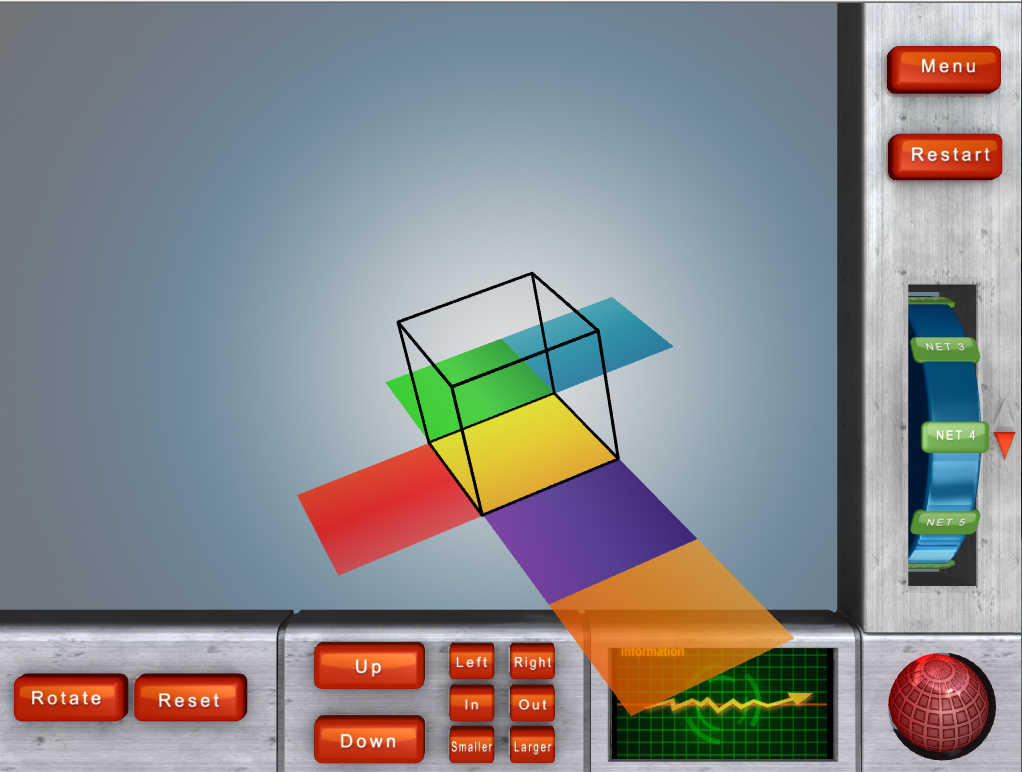
The initial 3D stereo interactives released by Spatial Thinking, with more on the way.
This software was clearly designed with the math classroom in mind, tackling the toughest problems with bravado. George Dekermenjian, the founder of Spatial Thinking, explains: “Our goal was to create an application that would serve as a bridge between the teacher’s mind and the students’ minds.”

An interactive stereo 3D simulation that can be used by teachers or students to promote deep questioning and understanding of solids and their nets.

Focusing on the mathematics behind space geometry and measurement, the Spatial Thinking math series focuses on the relationships between concepts of geometry that students often feel are unrelated and disconnected. It deploys animations of more than 100+ objects to make learning connections successful for students. Dekermenjian is definitely on track when he clarifies that “any product aimed at teachers and students must be one that inspires discovery, experimentation, and engagement. “ These interactives do just that. No joke. For 3D-using educators, this software is definitely a must see, and portends a bright future for this company. Take a look.

February 6, 2012

5D Does 3D


Here’s something you haven’t heard about in the 3D world, I bet. It’s on the edges of the 3D experience, I admit, but it’s worth knowing. This is a unique gift idea for you 3D-interested folks out in the blogosphere. Valentine’s Day is right around the corner, and this concept would also make sense for any 3D company wanting to give out awards, employee recognition trophies, or singular appreciation gifts to key customers.

I was in Orlando this week for some speaking engagements and I happened to come across a store with a mysterious sign:


Being early in the morning, the store was closed. The next day, I passed by the store again, and this time it was open for business. I entered the 5D - Foto store with keen skepticism and was immediately delighted.  These folks make crystals—and are able to inset 3D etchings (not 2D etchings) within the crystal. 


You can either pose live or send 2D pictures and have them rendered into 3D. You can insert images of people, objects, beloved pets, products, or even company logos.  I thought to myself, “This really makes sense if your business involves 3D.” Similarly, schools could use it to honor students, donors, retirees, or memorable teams. 


Interestingly, this is the only store of this type in the U.S. Four such operations exist in the U.K., however.

On a more macabre note, one of the options available, upon your death, is to insert your ashes and genetic signature in a crystal. The crystal is then inset with a 3D replica of your genetic DNA structure. It’s a more scientific way for friends and family to remember you.

January 30, 2012

On the Road Again


I’m doing quite a bit of presenting on 3D in education over the next six months. Here is a current list of my schedule and topics, in case you are interested in attending. If you are in the vicinity, it’s also always a good excuse for an opportunity to meet, get some coffee, and have some conversation.

Conference
Month and Location
Topic(s)
TCEA
February, Austin TX
5 Workshop: When 3D Comes to School
5 Teaching in 3D: Ten Reasons Why it Works, Why it Matters
Colorado Conversations
February, Wheat Ridge, CO
5 Evaluating Technology Initiatives
COSN
March, Washington, D.C.
5 Teaching in 3D: Ten Reasons Why it Works, Why it Matters
5 21st Century Teaching with New Media
5 Evaluating Technology Initiatives
Vision Performance Institute, Pacific University
June, Forest Grove, OR
5 3D in Education
3D Comm
June, Las Vegas, NV
5 Remapping for 2012: 3D and the Education Market Space
Colorado TIE 2012
June, Copper Mt., CO
5 Cultivating Your Donkey Cam Kung Fu
ISTE 2012
June, San Diego, CA
5 Teaching in 3D: Ten Reasons Why it Works, Why it Matters
5 Workshop: When 3D Comes to School

American Optometric Association
June, Chicago, IL
5 Panel: 3D in Education


January 23, 2012

Len's Favorite 3D Blogs

I thought it would be wise to “spread the love” just a little. I wanted to let you know about my favorite stereo 3D blogs, each very worthy of your attention:

Contains the latest research and information about eye and vision care of children, especially related to stereoscopic 3D.


A Canadian blog focused on the “art, science, culture, and business of stereoscopic 3D,” but I love the art and culture part the most.  


Estereoscopia3D
A blog with great insight and timely information, out of Portugal (turn on Google translation).


RealVision Blog
A Dubai-based blog that covers all the bases, ranging from the viewpoint of the cinematographer to that of the consumer.

Enjoy the journey!

January 16, 2012

A 3D Word Cloud (2011 Edition)


Here’s a graphic word cloud of all the key words used in our Future-Talk 3D blog during the year 2011.  The more the word is found, the larger it appears in this word cloud. (Click on the graphic to enlarge it.)


It’s quite interesting to visualize, in this way, the recurring themes and concepts that have emerged from Future-Talk 3D this last year. It’s like putting your fingers on the pulse of what’s happening in educational 3D—and taking a read.

January 9, 2012

Global FutureTalk


Добрый день         Bom dia         您好  مرحبا         こんにちは   Bienvenidos       


The Future-Talk 3D blog serves a diverse international audience. Our readers might be interested in seeing which countries were our top ten blog visitors during 2011. Based on web impressions for the 2011 calendar year, here is how the data shapes up:


Are there any surprises here? Or are these just “the usual suspects?” What do you think? Please comment.


Of course, this chart only represents the top ten. Many hundreds of other visitors have frequented this blog from countries all over the world. Future-Talk 3D blog has been visited by nearly every country in North, South, and Central America. The same is true for Europe. And the Middle East is broadly represented, too. Most of Asia has visited us, as well as more than 15 countries from Africa.  I see many others from Australia and Oceania, in addition.


I want to thank you for your deep and committed interest in 3D in education. Please write me, let me know what you are doing in your country. I would love to feature some interviews in 2012.


[Special Note: We have many visitors from Latin and South America, and I offer you a heartfelt ¡Gracias! -- Estoy a la espera de viajar a Colombia, Panamá, México, Costa Rica y Guatemala esta primavera, por lo que si le gustaría juntarnos para algún café y conversación, envíe un correo electrónico me.]

January 2, 2012

Editor's Choice


In our last post, we highlighted the most popular Future-Talk 3D blog posts for 2011, based on web impressions during the year. I was surprised to see that one particular post did not even make the top fifteen posts most visited by our readers: Why 3D Counts.

This omission surprised me, because this post identifies the underpinnings of 3D in learning—why 3D in education is so very important. This post connects to an insightful "meta-analysis" by Dr. Nora Newcombe, a whitepaper that goes a long way to explain why 3D holds promise for the classroom, for promoting interest in STEM careers, and for pushing math and science achievement forward. 

For that reason, I am starting 2012 with my “Editor’s Choice” reposting of a singular document that all Future-Talk readers, whether 3D supporters or detractors should read:
Increasing Math and Science Learning by Improving Spatial Thinking