March 12, 2012

In Méliès Shadow: A Gripping Story, a Hidden Allegory

Hugo (see the previous post) is the tale of a young lad trying to find purpose in his life following the untimely death of his father. But nestled within the plot is a unique story-within-a-story, a look at the budding history of early cinematography.


The view is through the eyes of Georges Méliès, a “special effects” cinematographer who was immensely popular and productive, producing well over 500 films in his day. A performing magician turned cinematographer, Méliès somehow never left behind his gift for magic, invention, and imagination as he pursued making movies. “I was convinced it was a new kind of magic,” he said of cinema.

Now, here’s where DLP-based stereo 3D comes in. This enchanting tale of the inchoate history of cinema creates a softly hidden allegory of today’s emerging 3D educational marketplace. The parallels are striking. Much like early film, 3D today seems like a “new kind of magic” to consumers and schools alike. “Movies are like seeing dreams in the middle of the day.”  I can’t think of a better way to describe 3D in the theater or the classroom. ”It was a gift!” Méliès voiced with delight about moving pictures. I see 3D in the same role—it’s a gift for learning and for healthy vision.

Moreover, viewer reactions to these early films then (and 3D movies or classrooms now) are eerily similar. In Méliès’ day, people responded with the same “it’s like being there” delight and physical reactions. One of the scenes depicted in Hugo involves a famous moment in film-going history, the brief screening of the Lumière brothers' Arrival of a Train at La Ciotat. Here’s a second YouTube version of the same film clip. Frankly, the visual surprise reenacted when the audience in Hugo saw this short video is no different than the reactions repeatedly evidenced in classrooms of elementary school students as 3D asteroids whizz by their heads on a simulated journey to the solar system. And it’s really not much different than the delight and connection demonstrated recently in Colorado and again in Austin by groups of adult K-12 educators at one of my 3D workshops. I guess there is one difference. The surprise and cognitive delight of viewing 3D does not seem to go away over time.


Méliès Shadow 
The similarities between the first years of moving pictures and our early experiences with stereo 3D don’t stop there. We see in both counterparts the struggles of the early years of making quality productions, the challenges of making a living on the basis of selling something as silly as imagination and wonderment, and the highs and lows of convincing others as to the true potential of the tool.

In Hugo, the magnificent and enthralling “world of imagination” created by Georges Méliès and others was driven away when World War I came. “Youth and hope were at an end,” lamented Georges. “The world had no time for magic tricks and movie shows… no one wanted my movies anymore.” “Happy endings only happen in the movies,” he added hurtfully. Due to the lack of demand for movies, he sold his company. Crushed and demoralized he invested all that he had left in a small toy shop. He felt that, in many ways, movies were just a fad. And the fad was over. 

Sometimes I feel the same way about 3D in education. What has become known as our ‘great recession” has hit manufacturer, software designer, and educational customer alike. At times, it seems like the economy has inopportunely slowed one of the most brilliant innovations of our time. Schools and universities that should be investing heavily in 3D learning technologies are instead focusing on keeping staff on the payroll. The critics of 3D are calling it either another fad or a luxury that cannot be afforded during tough times. Although I don’t want to ruin the movie, let me suggest that, in the end, Georges finds fresh legs. And in the 3D educational marketplace, there is reason for hope as well. You see, the educational market is resilient. It will bounce back. No, the message for DLP 3D’s potential in the classroom is not going to wither away. It will soon find fresh legs.


March 5, 2012

In Scorsese’s Shadow

3D again earned a noticeable presence at the 84th annual Academy Awards. Five awards (for best cinematography, art direction, visual effects, sound mixing, and  sound editing) went to the movie Hugo, the best breakthrough 3D movie I have seen since Avatar. This peculiar and enchanting film, based on the Caldecott award winning book, The Invention of Hugo Cabret, is even better than Avatar. (That’s also the opinion of James Cameron, Avatar’s director.) The film’s director was Martin Scorsese. I can only suggest you see this film before it leaves the theaters again.

Martin Scorsese embraced the 3D medium with every fiber of creative passion in his possession. But Scorsese’s work also casts a long and meaningful shadow on what we need to see in 3D within education settings.

Many of my friends and relatives recently have stopped going to 3D movies, citing visual dullness, drab conversions, and minimal negative parallax, but this powerful film demonstrates the type of creativity that will certainly bring the doubters back.  Hugo employs 3D for distinct artistic and visual advantage, a remarkable feat. It features extraordinary 3D portal views, the appearance of multiple layers of positive parallax, and positive parallax that is almost as good as negative parallax. During an interview with CbsNews.com, Scorsese spoke of the initial challenges he faced shooting in 3D, saying, "Everything changed every shot. Every shot. The placement of the actor. The nature of the performance...” The same attention to detail will be needed to support the continued development of educational 3D content. For the education market, simple 2D to 3D video conversion will not be sufficient in itself. Running comfortable 3D cartoons for educational customers in exhibit hall booths will not be enough.

And one more thing about Hugo. The movie successfully revives, after an uncomfortable drought, the beauty and importance of negative parallax.  Negative parallax is critically important in educational content. In Hugo, we see bountiful negative parallax: snow… ashes… dogs… tools… pendulums… guitar necks… hurting feet… hat brims… spit… devices… and tools. All with a specific purpose and message to convey.

In planning a party for her godfather, Georges, the spirited Isobel declares in the Hugo film: “We need to have some… panache!” Negative parallax in 3D is like panache. When panache matters, it matters. Educational 3D needs more panache (translated, negative parallax). Think of it in this way: educational customers will come when content has panache. 

February 27, 2012

Parallel Universe (Part II)


The following results were found in common to both the BVS3D and the LiFE I case studies (please refer to the previous post for context):
  • Retention.
  • Thinking in 3D. 3D learning affects how the mind’s eye approaches learning.
  • Improved Behavior. In-class student behavior improves both during and after 3D learning experiences.
  • Increased Focus. The ability of students to focus on the learning at hand increased due to the 3D experience. (This was labeled attentiveness in the LiFE I study and both focus and attention span in the U.S. study.)
  • Special Education Benefits. Students (especially male students) with attention disorders showed the most positive change in attention and learning behaviors.
  • Learning Transfer to Modeling or Essay Writing. Students in both studies performed better than those students with just 2D instruction.
  • Positive Student Reaction.

What can we learn from these common-ground findings? It is clear that we are starting to see emerging evidence that the educational benefits associated with teaching and learning in 3D roundly echo across oceans and distinct cultures. Regardless of the geographic location or cultural settings, it appears we are growing cautiously closer to understanding how 3D affects the brain, how it impacts learning, and how it can be employed to support effective teaching. Interestingly, here in the U.S., I hear of identical results coming from teachers employing 3D with such diverse groups as urban or rural students. 

February 20, 2012

Parallel Universe (Part I)


Two large-scale research projects exploring the effectiveness of stereo 3D in K-12 education offer us a “parallel universe” for comparing insight and results.

The first project (BVS3D) was fairly sizeable, involving four schools, eight classrooms, eight teachers, and over 570 student participants in Colorado. The LiFE I (Learning in Future Education) study, was even larger in size and scope, involving schools in seven European countries. (In the LiFE I case study, project sites were located in the U.K., France, Germany, Italy, Turkey, The Netherlands, and Sweden.) This project involved fifteen schools, fifteen classes, forty-seven teachers, and well over 740 students.  The final report for the LiFE I study was released and is available by registering here. The U.S. study, however, is not yet available. In this and the coming blog post, I want to highlight those results that were germane to both case studies. These overlapping areas of accord, featuring both U.S. and European perspectives, are both fascinating and informative.

In this first blog post, I want to clarify the environment and methodologies employed in these case studies:
  • First, both the U.S. and European studies involved a variety of school settings and grade levels. Both projects also favored science content delivered in 3D stereo.
  • In terms of methodologies, both case studies were similar. In each school there was a 3D class and a ‘control’ class. Both 2D and 3D classes were pre-tested and post-tested for content acquisition. In addition, both studies also incorporated qualitative feedback measures such as student and teacher surveys, classroom observations, and teacher/student interviews.

In next week’s post, we will highlight the results found in common to both the BVS3D and the LiFE I research projects.

February 13, 2012

Spatial Thinking


Over the next few months, I periodically plan to interview some of the educational 3D content developers that are making great strides in producing classroom-ready content. This is the first posting in that editorial line.

This week, we see the release of a new series of secondary-level stereoscopic 3D  math simulations by Spatial Thinking, a Los Angeles-based educational content developer, with a top-rate programming team in Beirut, Lebanon.  Spatial Thinking produces interactive simulations designed to teach difficult math concepts to students using the advantages of 3D stereo visualization. And it works. 

The initial 3D stereo interactives released by Spatial Thinking, with more on the way.
This software was clearly designed with the math classroom in mind, tackling the toughest problems with bravado. George Dekermenjian, the founder of Spatial Thinking, explains: “Our goal was to create an application that would serve as a bridge between the teacher’s mind and the students’ minds.”

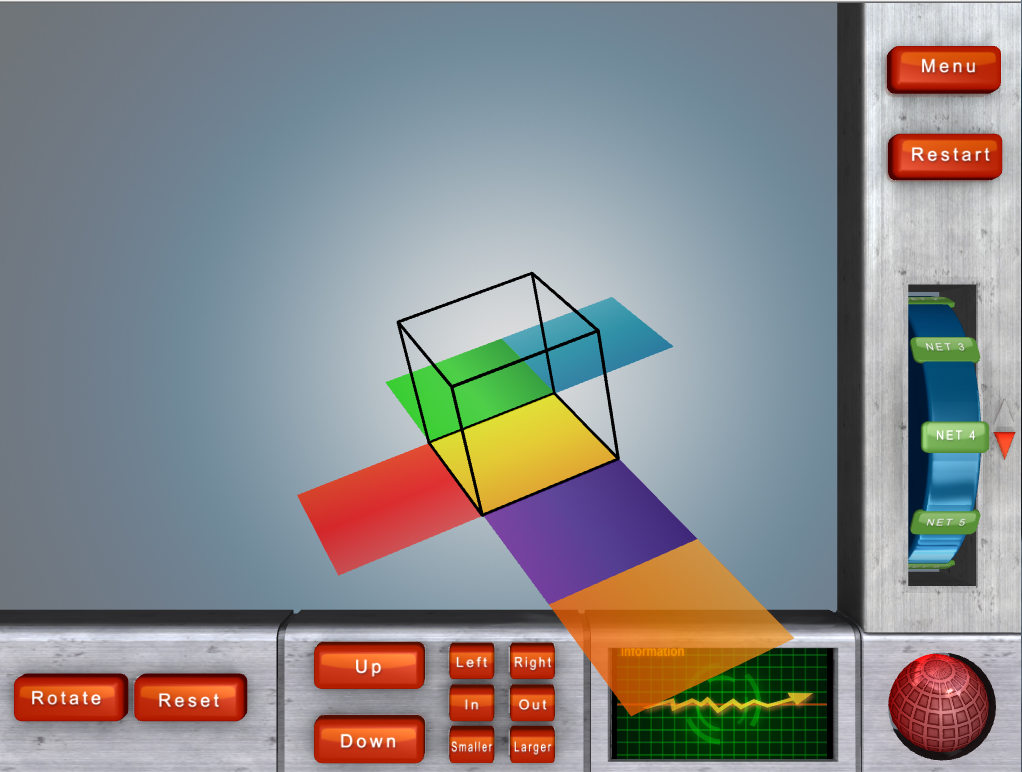
An interactive stereo 3D simulation that can be used by teachers or students to promote deep questioning and understanding of solids and their nets.

Focusing on the mathematics behind space geometry and measurement, the Spatial Thinking math series focuses on the relationships between concepts of geometry that students often feel are unrelated and disconnected. It deploys animations of more than 100+ objects to make learning connections successful for students. Dekermenjian is definitely on track when he clarifies that “any product aimed at teachers and students must be one that inspires discovery, experimentation, and engagement. “ These interactives do just that. No joke. For 3D-using educators, this software is definitely a must see, and portends a bright future for this company. Take a look.

February 6, 2012

5D Does 3D


Here’s something you haven’t heard about in the 3D world, I bet. It’s on the edges of the 3D experience, I admit, but it’s worth knowing. This is a unique gift idea for you 3D-interested folks out in the blogosphere. Valentine’s Day is right around the corner, and this concept would also make sense for any 3D company wanting to give out awards, employee recognition trophies, or singular appreciation gifts to key customers.

I was in Orlando this week for some speaking engagements and I happened to come across a store with a mysterious sign:


Being early in the morning, the store was closed. The next day, I passed by the store again, and this time it was open for business. I entered the 5D - Foto store with keen skepticism and was immediately delighted.  These folks make crystals—and are able to inset 3D etchings (not 2D etchings) within the crystal. 


You can either pose live or send 2D pictures and have them rendered into 3D. You can insert images of people, objects, beloved pets, products, or even company logos.  I thought to myself, “This really makes sense if your business involves 3D.” Similarly, schools could use it to honor students, donors, retirees, or memorable teams. 


Interestingly, this is the only store of this type in the U.S. Four such operations exist in the U.K., however.

On a more macabre note, one of the options available, upon your death, is to insert your ashes and genetic signature in a crystal. The crystal is then inset with a 3D replica of your genetic DNA structure. It’s a more scientific way for friends and family to remember you.

January 30, 2012

On the Road Again


I’m doing quite a bit of presenting on 3D in education over the next six months. Here is a current list of my schedule and topics, in case you are interested in attending. If you are in the vicinity, it’s also always a good excuse for an opportunity to meet, get some coffee, and have some conversation.

Conference
Month and Location
Topic(s)
TCEA
February, Austin TX
5 Workshop: When 3D Comes to School
5 Teaching in 3D: Ten Reasons Why it Works, Why it Matters
Colorado Conversations
February, Wheat Ridge, CO
5 Evaluating Technology Initiatives
COSN
March, Washington, D.C.
5 Teaching in 3D: Ten Reasons Why it Works, Why it Matters
5 21st Century Teaching with New Media
5 Evaluating Technology Initiatives
Vision Performance Institute, Pacific University
June, Forest Grove, OR
5 3D in Education
3D Comm
June, Las Vegas, NV
5 Remapping for 2012: 3D and the Education Market Space
Colorado TIE 2012
June, Copper Mt., CO
5 Cultivating Your Donkey Cam Kung Fu
ISTE 2012
June, San Diego, CA
5 Teaching in 3D: Ten Reasons Why it Works, Why it Matters
5 Workshop: When 3D Comes to School

American Optometric Association
June, Chicago, IL
5 Panel: 3D in Education


January 23, 2012

Len's Favorite 3D Blogs

I thought it would be wise to “spread the love” just a little. I wanted to let you know about my favorite stereo 3D blogs, each very worthy of your attention:

Contains the latest research and information about eye and vision care of children, especially related to stereoscopic 3D.


A Canadian blog focused on the “art, science, culture, and business of stereoscopic 3D,” but I love the art and culture part the most.  


Estereoscopia3D
A blog with great insight and timely information, out of Portugal (turn on Google translation).


RealVision Blog
A Dubai-based blog that covers all the bases, ranging from the viewpoint of the cinematographer to that of the consumer.

Enjoy the journey!

January 16, 2012

A 3D Word Cloud (2011 Edition)


Here’s a graphic word cloud of all the key words used in our Future-Talk 3D blog during the year 2011.  The more the word is found, the larger it appears in this word cloud. (Click on the graphic to enlarge it.)


It’s quite interesting to visualize, in this way, the recurring themes and concepts that have emerged from Future-Talk 3D this last year. It’s like putting your fingers on the pulse of what’s happening in educational 3D—and taking a read.

January 9, 2012

Global FutureTalk


Добрый день         Bom dia         您好  مرحبا         こんにちは   Bienvenidos       


The Future-Talk 3D blog serves a diverse international audience. Our readers might be interested in seeing which countries were our top ten blog visitors during 2011. Based on web impressions for the 2011 calendar year, here is how the data shapes up:


Are there any surprises here? Or are these just “the usual suspects?” What do you think? Please comment.


Of course, this chart only represents the top ten. Many hundreds of other visitors have frequented this blog from countries all over the world. Future-Talk 3D blog has been visited by nearly every country in North, South, and Central America. The same is true for Europe. And the Middle East is broadly represented, too. Most of Asia has visited us, as well as more than 15 countries from Africa.  I see many others from Australia and Oceania, in addition.


I want to thank you for your deep and committed interest in 3D in education. Please write me, let me know what you are doing in your country. I would love to feature some interviews in 2012.


[Special Note: We have many visitors from Latin and South America, and I offer you a heartfelt ¡Gracias! -- Estoy a la espera de viajar a Colombia, Panamá, México, Costa Rica y Guatemala esta primavera, por lo que si le gustaría juntarnos para algún café y conversación, envíe un correo electrónico me.]

January 2, 2012

Editor's Choice


In our last post, we highlighted the most popular Future-Talk 3D blog posts for 2011, based on web impressions during the year. I was surprised to see that one particular post did not even make the top fifteen posts most visited by our readers: Why 3D Counts.

This omission surprised me, because this post identifies the underpinnings of 3D in learning—why 3D in education is so very important. This post connects to an insightful "meta-analysis" by Dr. Nora Newcombe, a whitepaper that goes a long way to explain why 3D holds promise for the classroom, for promoting interest in STEM careers, and for pushing math and science achievement forward. 

For that reason, I am starting 2012 with my “Editor’s Choice” reposting of a singular document that all Future-Talk readers, whether 3D supporters or detractors should read:
Increasing Math and Science Learning by Improving Spatial Thinking

December 26, 2011

Best of Future-Talk 3D


It’s been a thriving year for the Future-Talk 3D blog, which has grown to nearly 2000 web impressions per month. As the year comes to an end, it is fitting to reflect on the most popular topical posts of 2011.  The top ten topical posts are presented below, in order of web impressions received:
1.      3D Myth Busting (most web impressions received overall)
2.      Why 3D Works
3.      BVS3D Case Study
4.      3D Myth Busting II
5.      What is eS3D?
6.      3D Content Update
7.      Research in Europe
8.      Past Research
9.      A 3D Salute

Actually, it’s quite thought provoking to speculate as to why these particular topics were “top of mind” for the diverse international audience that regularly follows this blog. Please let us know your hypothesis or thinking by posting a short comment.

December 19, 2011

Among the Best


This last week, the editors of eSchool News identified the “ten most significant educational stories” of 2011. Recent research on the emerging use of 3D in education made the cut. It's an interesting read. Check it out for yourself at:

December 12, 2011

Comforting Stories


Dr. Dominick M. Maino
In our previous post, we discovered the touching story of Strabby’s journey toward 3D vision. A practicing optometrist and leading vision health researcher, Dr. Dominick M. Maino (OD, MEd, FAAO, FCOVD-A and Professor of Pediatrics/Binocular Vision at the Illinois College of Optometry/Illinois Eye Institute in Chicago, Il) suggests that 3D-related vision problems are common. He crafted a 2010 editorial estimating the number of adults and children in the U.S. affected by what he calls a “binocular vision pandemic”:
“A clinical trial to determine the prevalence of binocular vision dysfunction within the general population suggested the possibility of up to 56% or 60 million men, women and young adults with symptoms associated with a binocular vision (BV) dysfunction, 45 million (61%) with accommodative problems and 28 million (38%) demonstrating various vergence anomalies.” [Study conducted in Spain]

Dr. Maino’s blog is a remarkable read for those who desire to learn more.  He also recommends reading a compelling book by Susan Barry entitled: Fixing My Gaze: A Scientist’s Journey into Seeing in Three Dimensions.

With increased societal exposure to 3D movies, 3D home television, 3D gaming, and 3D education, comforting stories of identification, treatment, and eventual transformation are rapidly spreading.  You see, 3D projected images can now be used as a universal public health screening tool for vision problems that previously went undetected. 

December 5, 2011

I Can See 3D!


Do you have any problems at all with viewing 3D?
If so, see your optometrist as soon as you can.
We live in a 3D world. That is part of the reason why young and old are naturally attracted to 3D in entertainment and education. But what is it like for a person who cannot see 3D in the natural world, like Johnny Depp, who we discussed in the previous post? More importantly, what is it like to be 3D blind and suddenly see in 3D? Such is the tale found in a most touching and eloquent blog, a journey I encourage everyone to read:


I post this link here in Future-Talk 3D so that we can all appreciate the importance of 3D vision health; so we can gain a sense of educational urgency for children, in order that years of struggling in school can be avoided; and so that we recognize the emerging role of 3D technology in both identifying and treating vision challenges.

November 28, 2011

Johnny Depp Can't See 3D


You may not know it, but Johnny Depp is unable to see 3D movies.  Read more about that here. But that hasn’t stopped him from producing Hugo, the best breakthrough 3D movie I have seen since Avatar. Directed by the renowned Martin Scorsese, I can only suggest you run (not walk) to a theater and see this movie. 

Many of my friends and relatives recently have stopped going to 3D movies, citing visual dullness, drab conversions, and minimal negative parallax, but this powerful film demonstrates the type of creativity that will certainly bring the doubters back.  This film, based on the Caldecott award winning book, The Invention of Hugo Cabret, employs 3D for distinct artistic and visual advantage, a remarkable feat. It features extraordinary 3D portal views, multiple layers of positive parallax, and positive parallax that is almost as good as negative parallax. And one more thing. The movie successfully revives, after an uncomfortable drought, the beauty and importance of negative parallax.  

In the film, one of the lead characters reminisces that movies are “like seeing dreams in the middle of the day.” The artistic use of 3D in this film makes that statement an even truer observation. Incidentally, this movie was so enthralling that the audience sat quietly and listened to the closing score well through the credits. The audience, young and old, was too stunned and enchanted to unseat themselves. (There is some research evidence that 3D visual effects are greatly enhanced by a rich audio experience.)

This movie shows what is possible for the future of 3D, and for the future of 3D in education. I will write about that in a future post. For now, take time to be delighted. See the movie.

November 21, 2011

Give Me Three!


I am not suggesting that the American Optometric Association has settled on an official mascot for their 3D educational platform, but some of their latest PR products are certainly child-friendly. Picture a cute frog:


And that’s not all. I love their new stickers, which carry the themes “Give Me Three!” or “I See 3.” Note the three froggie fingers. And the cool glasses. You get it!  Kids will love these, and that same time it will promote awareness for the importance of both 3D and healthy vision.

If you want to get ahold of some of these stickers or posters and such, they can be ordered through the AOA online store.  Non-members need to register – the URL above goes directly to the registration page. Another option is to go to www.aoa.org and hit the online store tab at the top, right side of the page. After registering, you will be quickly ushered to the ordering page, which looks like this:
Ordering Froggies
I ordered mine! A must-have collector’s item! In our next post, we’ll explain why this message is so important and much more than artful marketing…