November 12, 2012

Depth by PowerPoint

[NextGen 3D Content Series, Part 3]
Bringing the 3D Advantage to Presentations
I teach some very popular workshops on how to do teaching (or sales presentations) differently, based on how our minds work. Based on brain research, the techniques I employ cleverly draw the attention of the audience, while sustaining their focused attention on the learning at hand. Done well, these techniques can even go so far as to visually ‘delight’ the viewer. It’s all part of my personal campaign—my intentional effort—to utterly destroy the old notion of “death by PowerPoint,” the notion of tiresome, unimaginative, overly lengthy, and utterly boring PowerPoint presentations. Of course, the notion of “death by PowerPoint” is forever immortalized in such Dilbert cartoons as the PowerPoint Coma, the PowerPoint Chimp, and PowerPoint Poisoning

In the stereoscopic 3D world, many have tried to provide a way to convert traditional presentations into stereo 3D, hoping to capture the illusive golden goose ‘wow’ factor.  Our third entry in the field of  Next Generation Educational 3D content is Presente3D. This new startup aims to become nothing less than a game-changer for educators. What these folks are up to is so promising, I playfully call it Depth by PowerPoint, and I assure you it is a good thing, and for quite a number of very practical reasons. First, Presente3D enables 3D content creation through a truly easy-to-use and extremely flexible ribbon bar add-on to PowerPoint 2010. " It enables the educator, e-trainer, or student to turn their presentations into a 3D format, but more importantly, to turn any graphic or chart within a PowerPoint into a 3D object that can be manipulated in space and depth. Any object or text can be individually extruded and the z-depth adjusted, as well. Presente3D, with offices in New Jersey and a talented technical team in the Ukraine, offers the potential for some very creative and immersive presentations. Their easy and flexible process for designing 3D presentations also offers a stiff advantage: it’s easy enough to use that you can construct effective stereo 3D PowerPoint presentations the night before your presentation. Here an overview video and here is a video showing how their interface works. In addition, this tool is quite extensible. It runs on most portable devices, including Apple and Android operating systems, the iPad2, and all 3D TVs and projectors.

Yet, the significance of this effective new 3D tool lies with content creation. Perhaps 95% of educational 3D content currently available supports science instruction. Math content is well on its way toward a solid presence this year. But this tool opens up the floodgates of immediate amateur content creation for all the other subject areas, such as English, world languages, social studies, and the arts—to name a few. Think about it. There are over 500 million PowerPoint users worldwide. Currently, over 50 million PowerPoint presentations are made every day. Now, anyone can be able to create 3D content. It is simply content creation for the rest of us

November 5, 2012

Spatially Cool

[NextGen 3D Content Series, Part 2]
Our second featured nextgen company is Spatial Thinking, a California-based company with a talented international programming team located in both L.A. and Lebanon. Spatial Thinking is led by its founder, George Dekermenjian, who is a gifted master teacher and active college mathematics professor in his own right. Formed to exclusively serve the education space, Spatial Thinking builds interactive simulations that can be presented in stereoscopic 3D as tools for teaching and learning math for grades 4-12 and college math. Their flagship product is Space Geometry and Measurement 3D (SGM-3D and SGM-S3D). Both versions contain the same content, but the latter (SGM-S3D) is optimized to be viewed in stereoscopic mode while the former is produced in rendered 3D. This approach exemplifies a generally wise strategy for success in the stereo 3D marketplace: offering 2D content as well as 3D content. When schools are ready, the shift to 3D is easy and costs less.
Using 3D to teach concepts that are harder to learn without stereo 3D.
I chose Spatial Thinking as an example of one of my nextgen educational 3D content developers for five main reasons:
  1. This company starts with the premise of the added value stereo 3D can bring to learning; I like that. Spatial Thinking produces simulations that use stereo 3D to an advantage, concepts that lend themselves naturally to 3D visualization. Essentially, that means using 3D to teach concepts that are difficult to learn without 3D.
  2. Spatial Thinking understands the educator perspective as much as they understand the technology of 3D visualization. This company demonstrates an openness to learn and do what schools, teachers, and students want and need, not just pursue the technology for its own sake.
  3. Their content represents a significant move beyond the current hegemony of science content in the 3D educational marketplace—and math is a great place to start.
  4. They are not developing just a few quixotic titles—they are developing quite a few key math concept sims. (You see, if there are not many resources to choose from, my experience is that teachers won’t spend time to learn to use the technology.)
  5. They surround their software with exactly the kinds of supporting materials that teachers are dying for: visual PowerPoint supports, lesson guides, and extension materials.
Topics covered on the “Space Geometry and Measurement” (SGM)
product from Spatial Thinking.
Stereo 3D educational software designed the way teachers like to teach.
In this series, I asked each content provider to explain what was so defining about their approach to 3D content. In designing their software, Dekermenjian noted his desire to “creatively use negative-parallax to highlight key ideas of particular concepts” and importance of “ensuring each lesson/module could be explored in 10 minutes or less, leaving enough class time for reflection, discussion, practice, assessment and review.”

Spatial Thinking’s plans to build additional interactive stereo content for other areas of mathematics, such as analytic geometry, calculus (high-school and college level), and other higher mathematics courses typically offered at the college level or beyond. Spatial Thinking’s web site can be found at: www.spatialthinkingllc.com.


October 29, 2012

Sensavis [1]

Sensavis creates 3D products with incredible realism and stop-
action manipulation. And their content runs on iPads.
Our first featured nextgen company is a remarkably skilled group out of Sweden, Sensavis. They offer products in the field of corporate and medical education, marketing, and visualization. I've explored their products and works-in-progress first hand and found myself nothing less than stunned. I have seen it all with regards to 3D educational products on the market, and this is the best imagery I have seen. More importantly, it works the way teachers and professors really want 3D learning to work, based on the end-of-project teacher interviews conducted following our year-and-a half case study in the Boulder Valley School District. In a past blog post about educational content, “What is eS3D,” I describe five of the key attributes of outstanding 3D educational content, and the Sensavis masters all five

Sensavis has produced an Interactive 3D Human Framework (I3HF), which approaches discovering the human body from a physiological perspective – meaning that you see fluids flowing and particle systems moving, not just 3D learning objects. Their presentations are so completely interactive, you can zoom endlessly from macro to micro, steer around, or choose from a navigation client to add slides or film into the model. If only they would create content for the high school market!


Sensavis' app, Heart Interactive, demonstrates
their use of simulation in rendered 3D.  Their
content is also produced in stereo 3D. 
One of the many efforts now underway at Sensavis is a high end "interactive 3D heart project.” This involves software that integrates Sensavis’ technology with real time data from a heart simulation developed jointly by the internationally respected Karolinska University Hospital and KTH Royal Institute of Technology in Sweden. Using their product, Sensavis intends to "steer" the heart “in real time” in order to conduct various simulations, conditions, and treatment effects. (If you would like to glimpse at the quality of their visualizations, download the free Heart Interactive app from the App Store—search for 'Sensavis' or 'Heart Interactive' and you will find it easily.)

Sensavis’ remarkable vision, driven by CEO Magnus Arfors and a world-class development team, is grounded in several fundamental beliefs. First, Arfors suggests that “Humans were equipped to learn through experience. The closer we can get to an experience of a message, the closer we get to an understanding of that message (and in shorter time).” Interactivity is key to his notion of experience. Arfors explains: “Film is linear, yet interactive content is non-linear. You choose where you want to go.”   Arfors offers a simple formula for 3D success: “3D + interaction = understanding and recollection.” He reminds us: “Regardless whether the interactive 3D content is for general education, learning science, or used in marketing—it enhances understanding and stimulates the learning process in a way that the audience is engaged and remembers the experience and the messages.” Arfors’ theories translate well into practice. Two weeks ago, a professor used the Sensavis’ 3D In Vitro Fertilization (IVF) visualization in her lecture for 100 medical students at the Karolinska University Hospital. Arfors gleams: “This was their première for interactive 3D content and already the enthusiasm is spreading internally at the university.

Second, the strength of Sensavis’ approach and expertise asserts itself at the precise point where “IT, visualization, and academic competence meet.” He clarifies: “We strive for realism, both in movements and in visual quality (we put very high demands on our software). Most importantly, Arfors notes: “A key characteristic of our content is that we want to picture ‘alive’ environments, i.e., the human body in operation (physiology).”  

Third, Sensavis’ accomplishments are grounded in solid technological advantage. They have developed their own visualization engine. They have reliable hardware delivery platforms, including an auto-stereoscopic streaming solution that can be used for companies desiring to distribute education content to local sites, universities, or hospitals from a central server. And they are agile enough to take on special projects in the fields of science or education. (For example, Sensavis just completed a production focused on In Vitro Fertilization (IVF), visualizing the achievements behind the Nobel Prize in Physiology or Medicine (2010).

I have often stated that my personal vision is to make the world of teaching and learning a better place, to enable the kind of teaching that fully engages and challenges our 21st century learners. I believe Sensavis’ creativity clearly moves us in that direction. Sensavis can be reached at www.sensavis.com.


October 22, 2012

NextGen Educational 3D Content

The current generation of educationally focused content available in stereo 3D is very usable in schools. It is often quite impressive from the perspective of teachers and students.  (See my comprehensive list of all currently available educational stereo 3D content here.) The future, however, promises to be even better. Behind closed doors, content developers are working feverishly on the next generation of stereo 3D educational content. And I’m not talking about movies here. I am referring to software specifically designed to bring together as many of these characteristics as possible: tremendous artistry, solid curricular and educational fit, and practical and easy software delivery—all while aiming to leverage the real strengths of the stereo 3D medium in the classroom.
Future educational stereo 3D content (eS3D) offers these defining characteristics
Interestingly, these efforts are happening across the globe, not solely in the U.S. Over the last six months I have quietly reviewed the visions and products of a number of different companies. I’ve sat down with each of them, all the while thinking deeply about what’s happening with the coming generation of 3D educational content. The companies I plan to highlight in the coming series of posts are not the only firms that are working on nextgen stereo 3D for the educational market, but these companies offer a mouthwatering hint of what is now emerging. At the very least, this series presents a rare opportunity to delve into the minds and motives of some of the most inventive and promising 3D educational software developers in the world. 

October 15, 2012

San D (2)

As discussed in the previous post, 3D is really taking off in Asian and other emerging markets. Since many of our regular blog readers come from these emerging markets, I thought a thoughtful reminder, presented via a simple mystery, might be beneficial: Can you see anything peculiar in this snapshot of the first showing of Titanic 3D in Shanxi, China? Click on it to enlarge it. 
What's Wrong with this Picture?
Leonard Press, a well-known optometrist, recently observed in his blog that a number of people are watching the film without glasses.  He explains, when “you’re experiencing one of the 3Ds of stereoscopic 3D viewing—discomfort, dizziness, or lack of depth—one way to cope is to simply watch without the 3D glasses – but the experience is clearly not the same and most likely is out of focus due to the effects necessary to create 3D-ness for your movie-going neighbors.”
Again, and this time internationally speaking, our educational challenges remain constant. We know from the research that 3D is not harmful in any way. But some people do experience discomfort, which actually is an indication of underlying vision problems, not necessarily a problem with the 3D. For a complete resource on understanding the role of 3D in vision health and vision screening, see this well-travelled Future-Talk 3D post.


October 8, 2012

San D (1)


San D is how you say 3D in Mandarin Chinese. You see, that’s important to know these days. It’s because most of the interest in 3D entertainment and 3D TVs these days appears to be in China, followed by Western Europe and key emerging markets (Russia, Latin and South America, and the Middle East). Although TV sales across the world are generally in decline, some sources suggest upwards of 10-20 million 3D TVs will be sold in China this next year. I remember how high the interest was in 3D when I first spoke in Beijing at their first ever 3D Innovation Forum.

In the U.S., things are still different. U.S. sales of 3D TVs are lagging far behind. James Mathers, president of the Digital Cinema Society notes that, although “most major filmmakers have successfully embraced 3D,” 3D-ready TV sales are “abysmal” in the U.S. and “are only expected to reach the cumulative 7 million unit mark by the end of the year.” Norbert Hildebrand of Display Central (check out this website—it offers comprehensive one-stop information about all things 3D) agrees. He suggests that “the U.S. is actually a slow adopter of this new technology compared to other regions, like Europe and China. I also found it interesting that, during the well-attended 3D Entertainment Summit held in Hollywood in late September, one attendee observed that “Americans seem to have a bias against 3D compared to other countries.”

I continually get that same sense. Even in the education market. But I think the 'resistance' reasons are vastly different for the U.S. education marketplace. Educational 3D is not about 3D TV at all. In education, I think any perceived resistance is due to the tough recession facing schools (hopefully short-lived) and generational issues. By generational issues, I mean to say “kids want it.” Adults—not so much. Kids don’t mind the glasses—adults don’t know any better. For more background on this topic, please revisit my original post on this topic: On Youthful Shoulders. In the meantime, I still see innovators and pioneers in education showing keen interest in 3D. Don’t give up!

October 1, 2012

Panning for Gold (Part 3)


As my prospecting efforts come to an end for the summer, two more glittering specks of 3D gold (and one speck of silver) are visible in my virtual gold pan:

3D Printing
3D printing companies started to make a splash at various conferences this past summer. 3D printing is just another way for students working with rendered or stereo 3D design to bring their creations into the physical world. These systems are expensive, but their increased presence at conferences speaks to an interesting growth phenomenon.

The Korean Factor
A most refreshing customer experience during my gold panning efforts this summer occurred at InfoComm at the Korean Pavilion. In a 3D-dedicated area, they featured some of the finest 3D educational content (cultural and historical documentaries) I have ever seen. They were good. Very good. Visually compelling, not 3D dribble. I am not sure they know how good this content really is. I want to locate some of this content. Remember, 3D as a medium can only be explained, sold, or advanced well if we have great content in hand. I know we have many readers from Korea who frequent this blog. Can you help us identify this content? Can our Korean readers help reveal this content to the world?

DisplayNote
Okay, this is not 3D. I know that. That’s why I said there was a speck of silver in my gold pan. (Yes, it is quite possible to pan for silver.) This software is so promising, that I must tell educators about it. DisplayNote is an Irish startup with a product designed to share, annotate, and communicate student displays across platforms and across devices. I can share my laptop screen to each device, share a device’s screen to my classroom projector so all students can see, see what students are working on when using their own devices, annotate non-destructively on top of my screen or theirs, and so on.
At various conferences, I saw large-district CIOs, major thought and opinion leaders, and journalists quietly interviewing the DisplayNote staff in one-off discussions. I haven’t seen so many power players quietly drawn to one booth in a very, very long time. Here is a video explanation of their product. The flexibility and potential of this product in the classroom—given its ability to support multiple platforms, multiple devices (think iPads and tablets), and even enhance the role of the traditional classroom projector and preferred pedagogical styles of teachers at the primary, secondary or higher education level—is noteworthy. A fleck of silver.


September 24, 2012

Panning for Gold (Part 2)

As we continue prospecting for 3D gold, here are two more flakes I found in the gold pan as our hot summer came to an end:

e-Animations Comes Out to Play
A new and promising stereo-3D educational content producer started exhibiting their wares in the U.S. this summer: e-Animations. Based in Hungary, this company has a lot to offer, including exceptional artistry and reasonable pricing. You can preview some of their animations (in 2D) here on VIMEO.

New Active Glasses for Education
XPAND leaders were in the aisles and byways at most conferences this summer, visiting various booths and some of my presentation sessions. They were also showing (in one-off settings) their latest active glasses for the education market, the EDUX 3 series. These new glasses offer a TN lens (clearer, with no green tint), CR2032 replaceable batteries (which can be purchased from any store), folding arms (for better storage and fit), and an on-off switch. Distances for viewing and durability remain a high plus for these glasses, and the price has been lowered significantly from last year. I expect XPAND to remain strong in the education market with their continuing commitment to continuous improvement and price reduction.

***
Do you have a new product for the education market or are you updating a previous product? Do you have an interesting story to tell? If so, please contact me for an interview.


September 17, 2012

Panning for Gold (Part 1)


Gold panning takes patience. A gold panner looks for placer deposits, fills the bottom of his/her favorite pan with anticipation, and then meticulously manipulates the pan to filter gold from the heavies and black silt that layer the dark bottom ridges of the gold pan. It’s not easy work, but it can be rewarding, given the staggering price of today's gold.
Gold panned recently in Colorado
by my son-in-law

Gold panning for great technology is no different. During difficult financial times, it’s not easy to find real nuggets, those bold counterstrokes of innovation and potential that can produce glimmers of hope in a tough market. In the next three consecutive posts, I'll highlight a few of the new 3D-related products that bounced across my preternatural radar this summer.  
Here's the first revelation, and it's quite interesting: Optoma offered a wonderful idea this summer. They showed how to use an ultra-short throw DLP 3D projector, along with interactivity, to create a unique interactive tabletop display surface. For a live demonstration, see this video
It’s basically an interactive whiteboard, with 2D or 3D, on any tabletop surface. This makes a lot of sense for schools, learning centers, museums, and other spaces that like to conduct smaller, more personalized tabletop simulations or exercises. It even makes sense for school and emergency preparedness training for small group training. I expect this approach to really resonate with educators. Think about how you might apply this idea in your own setting.

September 10, 2012

Teaching with Depth

Grasping for words. In search of just-the-right language. Looking for richer metaphors. These best describe what has been occupying my think time in recent months. You see, the expression ‘3D’ carries a lot of unwanted baggage. 

For most, the expression ‘3D’ conjures to their minds little more than movies—‘pokey’ entertainment.  Some people immediately associate the term ‘3D’ with architectural drawings (CAD), Google Earth, gaming, or other types of “rendered 3D” objects or scenescapes. Then there’s a well-known film critic, who speaks for many, in suggesting that “‘3D—it just makes me sick.” (He was unaware of the research findings that indicate his discomfort is caused by underlying vision issues, which are easily addressable. But that’s another story.) For many others, ‘3D’ is simply not a part of their generation and therefore not on their radar.

Using the term “stereo 3D” doesn’t seem to help either. Adding that double-fisted adjective merely adds a pinch of technophobe seasoning to the mix. No, I’ve been looking for a kinder, gentler pathway. So far, I have settled on the following:
Teaching and learning with DEPTH is a pleasant way to describe how we use 3D in educational settings. It’s an expression that is, at once, both hopeful and free of the past, largely unwarranted, baggage. So far, it seems to resonate well with educators and educational conference leaders. 

Do you have any similar musings? Other ways to word the notion of the 3D experience? Please post them as a comment below.

September 3, 2012

FutureTalk Expands


FutureTalk 3D has been doing very well, thanks to your committed involvement as readers.  Thank you so very much! This blog is now reaching 2,300 web impressions a month, with our readers coming from nearly every country in the world. That’s quite exciting for a blog dedicated solely to the emerging role that 3D is playing in all spheres of the educational enterprise (including K-12, university, optometric, medical, industry, and even patient, customer, and sales force education).

 
And just so you know- so that you don’t get confused—we are expanding the FutureTalk concept to incorporate a new blog called FutureTalk VIZ. This new blog has the same moniker—FutureTalk—but is not focused on 3D. It is instead dedicated to the world of classroom visualizers or document cameras

 
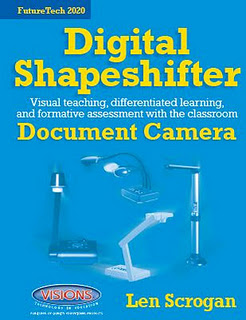
I recently published Digital Shapeshifter, the leading resource on creative teaching with classroom document cameras, and this new blog will become a living extension of that book. (Of course, the book does contain a few sections on the topic of stereo 3D visualization with document cameras.) FutureTalk VIZ is merely a new “startup,” a new blog operating in its own sphere of influence within the FutureTalk brand.
On the other hand, FutureTalk 3D will continue its 3D-in-learning emphasis, with many exciting, ground-breaking, and even controversial topics looming on the horizon. Stay tuned.

August 27, 2012

3D Vision Basics

The 'old' way
The 'new' way

If you are a bit unfamiliar with the role of 3D in supporting vision health and improved learning for children, you may want to watch this short video of James Sheedy, O.D., Ph.D., explaining how 3D viewing helps diagnose vision problems. It was filmed in Chicago during the American Optometric Association’s annual membership conference. It also addresses the importance of our natural 3D vision in successful student learning.

Also, watch the rough video below to see an example of how TrueVision uses 3D in eye surgery education to show clarity and depth:

August 20, 2012

3D Vision News

For the first time in history, the Opening General Session for Optometry’s Meeting® in Chicago in the last week of June featured an educational 3D experience led by a number of Hollywood dignitaries. The audience included attending doctors of optometry, students, paraoptometrics, and their families. (For perspective, there are over 60,000 optometrists in the United States alone.)
At the opening session, 3D experts Jim Chabin (president of the International 3D Society), Buzz Hayes (senior vice president and executive stereoscopic 3D producer for Sony 3D Technology Center at Sony Pictures Entertainment), Graham Clark (StereoD, LLC), and Bob Whitehill (stereoscopic supervisor at Pixar Animation Studios) demonstrated and explained the concepts of 3D as it pertains to the entertainment world. They showed 3D clips from films such as “The Lion King,” “Rise of the Guardians,” “Spiderman” and “Titanic”, among others. Many of these clips have never been seen outside their studios. 
Jim Chabin, president
of the International 3D Society
Jim Chabin, the president of the International 3D Society, stated “We ask your help in making sure stereo deficiencies are corrected.” Chabin continued, “We hope amblyopia rates can be reduced and decimated. We hope your practices can provide appropriate diagnoses. You are important partners in 3D; you are the first responders.”

Why was this event so important? Simply stated, the science behind stereoscopic 3D is an essential step to increased understanding of 3D and stereoscopic 3D (S3D) viewing as a safe and appropriate technology for all audiences.  As the popularity of 3D rises, so too will optometry’s responsibility to educate the public and assist the production studios and other 3D developments. As Jim Chabin suggests, optometrists are the nation’s 3D “first responders.” For that reason, this opening session was clearly a landmark educational opportunity.

The Opening General Session was followed by a number of educational sessions focused on the topic of 3D vision/diagnosis/treatment, along with a very comprehensive Saturday symposium on the 3D experience.  During the Saturday symposium, optometric professionals had the opportunity to take a journey through the entire process of 3D, plus experience the first-ever live, heads –up, 3D slit lamp exam demonstration (a diagnostic technology developed by TrueVision). Anthony Lopez, a 3rd year student of optometry was in the audience and was fortunate to be the “first ever optometry student” to experience a slit lamp exam using this new 3D technology. There is clearly a promising role for 3D in the world of optometric diagnosis and treatment. 

August 13, 2012

Summer 2012 eS3D Content Update


Below please find my Future-Talk 3D August 2012 list of producers of 3D educational content. These content producers are listed in alphabetic order, along with a few salient comments that are worth a look. Links are provided and the entire file is downloadable. If you are a 3D educational content manufacturer, and you are not yet on this list (but would like to fill me in on your intentions), please contact me directly.

                                    Open publication - Free publishing - More 3d


August 6, 2012

eS3D Content Grows


Everywhere I go, the first question educators and industry leaders ask me about 3D in education is entirely predictable: “What kind of content is available in 3D?” On LinkedIn and other websites, the same question endlessly churns on throughout the year. Here's the answer. Twice a year, I release a special report on stereo 3D content available specifically for the educational market. I call it educational stereo 3D or eS3D for short.

I started reporting my comprehensive list in January, 2010. My first report highlighted seven software companies producing stereo 3D content for the educational market. That’s all we could find at that time. Something interesting has happened along the way. Today, two-and-a-half years later, our awareness of the number of 3D educational content publishers has grown to twenty-five. That’s more than a 350% increase. And it’s still growing. Please remember—with most of this content, we are not talking about “3D movies.” In fact, 3D educational content represents a diversity of approaches and design. (See my chart below, clicking on it to expand the view.)


Another interesting development to watch is the increasing emergence of more content for the elementary classroom.

Come back to Future-Talk 3D next Monday for my Summer 2012 posting of 3D educational content producers. Next week, I will post the complete downloadable list of content producers, listing each in alphabetic order with links to the best spots in their web pages. What a great way to start the school year!